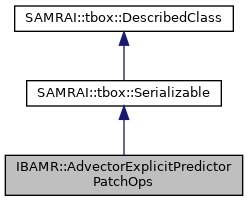
|
| | AdvectorExplicitPredictorPatchOps (const std::string &object_name, SAMRAI::tbox::Pointer< SAMRAI::tbox::Database > input_db, bool register_for_restart=true) |
| |
| | ~AdvectorExplicitPredictorPatchOps () |
| |
| const std::string & | getName () const |
| |
| double | computeStableDtOnPatch (const SAMRAI::pdat::FaceData< NDIM, double > &u_ADV, const SAMRAI::hier::Patch< NDIM > &patch) const |
| | Compute the maximum stable time increment for the patch. More...
|
| |
| void | computeAdvectiveDerivative (SAMRAI::pdat::CellData< NDIM, double > &N, const SAMRAI::pdat::FaceData< NDIM, double > &u_ADV, const SAMRAI::pdat::FaceData< NDIM, double > &q_half, const SAMRAI::hier::Patch< NDIM > &patch) const |
| | Compute the advective derivative \( \vec{N}^{n+\frac{1}{2}} = \vec{u}^{\mbox{\scriptsize ADV},n+\frac{1}{2}} \cdot \nabla q^{n+\frac{1}{2}} \) using the specified advection velocity and predicted face-centered values. More...
|
| |
| void | computeFlux (SAMRAI::pdat::FaceData< NDIM, double > &flux, const SAMRAI::pdat::FaceData< NDIM, double > &u_ADV, const SAMRAI::pdat::FaceData< NDIM, double > &q_half, const SAMRAI::hier::Patch< NDIM > &patch, double dt) const |
| | Compute the time integral of the advective fluxes \( \vec{f} \) corresponding to a face-centered value \( q \) and a MAC advection velocity \( \vec{u}^{\mbox{\scriptsize ADV}} \). More...
|
| |
| void | predictValue (SAMRAI::pdat::FaceData< NDIM, double > &q_half, const SAMRAI::pdat::FaceData< NDIM, double > &u_ADV, const SAMRAI::pdat::CellData< NDIM, double > &Q, const SAMRAI::hier::Patch< NDIM > &patch, double dt) const |
| | Compute predicted time- and face-centered values from cell-centered values using a second-order Godunov method (non-forced version). More...
|
| |
| void | predictValueWithSourceTerm (SAMRAI::pdat::FaceData< NDIM, double > &q_half, const SAMRAI::pdat::FaceData< NDIM, double > &u_ADV, const SAMRAI::pdat::CellData< NDIM, double > &Q, const SAMRAI::pdat::CellData< NDIM, double > &F, const SAMRAI::hier::Patch< NDIM > &patch, double dt) const |
| | Compute predicted time- and face-centered values from cell-centered values using a second-order Godunov method (forced version). More...
|
| |
| void | predictNormalVelocity (SAMRAI::pdat::FaceData< NDIM, double > &v_half, const SAMRAI::pdat::FaceData< NDIM, double > &u_ADV, const SAMRAI::pdat::CellData< NDIM, double > &V, const SAMRAI::hier::Patch< NDIM > &patch, double dt) const |
| | Compute predicted time- and face-centered MAC velocities from a cell-centered velocity field using a second-order Godunov method (non-forced version). More...
|
| |
| void | predictNormalVelocityWithSourceTerm (SAMRAI::pdat::FaceData< NDIM, double > &v_half, const SAMRAI::pdat::FaceData< NDIM, double > &u_ADV, const SAMRAI::pdat::CellData< NDIM, double > &V, const SAMRAI::pdat::CellData< NDIM, double > &F, const SAMRAI::hier::Patch< NDIM > &patch, double dt) const |
| | Compute predicted time- and face-centered MAC velocities from a cell-centered velocity using a second-order Godunov method (forced version). More...
|
| |
| void | enforceIncompressibility (SAMRAI::pdat::FaceData< NDIM, double > &v_half, const SAMRAI::pdat::FaceData< NDIM, double > &u_ADV, const SAMRAI::pdat::FaceData< NDIM, double > &grad_phi, const SAMRAI::hier::Patch< NDIM > &patch) const |
| | Subtract the face-centered gradient of a scalar from a predicted face-centered velocity field to enforce incompressibility approximately. More...
|
| |
| int | getNumberCellGhosts () const |
| | Get the number of ghosts cells required by the limiter for cell-centered and face/side-centered variables. More...
|
| |
| int | getNumberFluxGhosts () const |
| | Get the number of ghosts cells required by the limiter for face-centered fluxes. More...
|
| |
| void | putToDatabase (SAMRAI::tbox::Pointer< SAMRAI::tbox::Database > db) override |
| | Write state of AdvectorExplicitPredictorPatchOps object to the given database for restart. More...
|
| |
Class AdvectorExplicitPredictorPatchOps implements the predictors required to use an explicit predictor-corrector method to solve the non-conservative advection equation,
\[ \frac{dQ}{dt} + (\vec{u}^{\mbox{\scriptsize ADV}} \cdot \nabla)Q = F, \]
where \(Q\) is a cell-centered quantity, \(\vec{u}^{\mbox{\scriptsize ADV}}\) is a specified face-centered advection velocity, and \(F\) is an optional source term. These methods can also be used to solve the advection equation in conservation form,
\[ \frac{dQ}{dt} + \nabla \cdot (\vec{u}^{\mbox{\scriptsize ADV}} Q) = F. \]
The class employs an upwind (Godunov) explicit predictor which can be used to generate time and face centered values or fluxes. These predicted values can be used in a second-order accurate predictor-corrector method for solving the advection equation, as well as related problems such as the advection-diffusion equation and the equations of incompressible flow.
Note that the predicted fluxes are computed using the non-conservative form of the advection equation. Consequently, when the advection velocity \(\vec{u}\) is not discretely divergence free, the appropriate non-conservative form of the source term must be supplied to the predictor in-order to obtain a formally consistent method.
- See also
- IBAMR::AdvectorPredictorCorrectorHyperbolicPatchOps
In three spatial dimensions, the face-centered advective fluxes \( \vec{f} \) are defined by
\begin{eqnarray*} f_{i+\frac{1}{2},j,k}^{n+\frac{1}{2}} &=& \Delta t \, *u_{i+\frac{1}{2},j,k}^{\mbox{\scriptsize ADV},n+\frac{1}{2}} \, *q_{i+\frac{1}{2},j,k}^{n+\frac{1}{2}} \\ f_{i,j+\frac{1}{2},k}^{n+\frac{1}{2}} &=& \Delta t \, *v_{i,j+\frac{1}{2},k}^{\mbox{\scriptsize ADV},n+\frac{1}{2}} \, *q_{i,j+\frac{1}{2},k}^{n+\frac{1}{2}} \\ f_{i,j,k+\frac{1}{2}}^{n+\frac{1}{2}} &=& \Delta t \, *w_{i,j,k+\frac{1}{2}}^{\mbox{\scriptsize ADV},n+\frac{1}{2}} \, *q_{i,j,k+\frac{1}{2}}^{n+\frac{1}{2}} \end{eqnarray*}
where \( \vec{u}^{\mbox{\scriptsize ADV}} = (u^{\mbox{\scriptsize ADV}},v^{\mbox{\scriptsize ADV}},w^{\mbox{\scriptsize ADV}}) \) is the MAC advection velocity. Analogous formulae hold in other spatial dimensions.
The predictor assumes that \( Q \) satisfies an equation of the form
\[ \frac{dQ}{dt} + (\vec{u}^{\mbox{\scriptsize ADV}} \cdot \nabla)Q = 0, \]
i.e., that \( Q \) satisfies the advection equation in non-conservative form.
Note that if the advection velocity is not discretely divergence free, and if the predicted velocities are to be conservatively differenced (i.e. used in a discretization of the conservative form of the equation), a consistent method is obtained only when the proper source terms are included
- See also
- predictValueWithSourceTerm
The predictor assumes that \( Q \) satisfies an equation of the form
\[ \frac{dQ}{dt} + (\vec{u}^{\mbox{\scriptsize ADV}} \cdot \nabla)Q = F, \]
i.e., that \( Q \) satisfies the forced advection equation in non-conservative form.
Note that if the advection velocity is not discretely divergence free, and if the predicted velocities are to be conservatively differenced (i.e. used in a discretization of the conservative form of the equation), a consistent method is obtained only when the proper source terms are included
- See also
- predictValue
The predictor assumes that \( \vec{V} \) satisfies an equation of the form
\[ \frac{d\vec{V}}{dt} + (\vec{u}^{\mbox{\scriptsize ADV}} \cdot \nabla)\vec{V} = 0, \]
i.e., that \( \vec{V} \) satisfies the advection equation in non-conservative form.
Note that if the advection velocity is not discretely divergence free, and if the predicted velocities are to be conservatively differenced (i.e. used in a discretization of the conservative form of the equation), a consistent method is obtained only when the proper source terms are included
- See also
- predictNormalVelocityWithSourceTerm
The predictor assumes that \( \vec{V} \) satisfies an equation of the form
\[ \frac{d\vec{V}}{dt} + (\vec{u}^{\mbox{\scriptsize ADV}} \cdot \nabla)\vec{V} = *\vec{F}, \]
i.e., that \( \vec{V} \) satisfies the forced advection equation in non-conservative form.
Note that if the advection velocity is not discretely divergence free, and if the predicted velocities are to be conservatively differenced (i.e. used in a discretization of the conservative form of the equation), a consistent method is obtained only when the proper source terms are included
- See also
- predictNormalVelocity