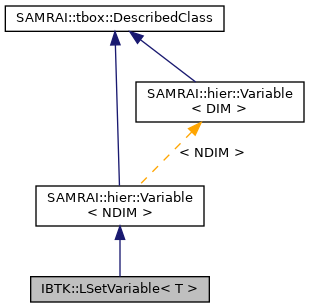
Class LSetVariable provides a SAMRAI::hier::Variable class corresponding to patch data of type LSetData.
#include <ibtk/LSetVariable.h>
◆ LSetVariable() [1/3]
◆ ~LSetVariable()
◆ LSetVariable() [2/3]
- Note
- This constructor is not implemented and should not be used.
◆ LSetVariable() [3/3]
- Note
- This constructor is not implemented and should not be used.
- Parameters
-
| from | The value to copy to this object. |
◆ dataLivesOnPatchBorder()
Return false since the LSet data index space matches the cell-centered index space for AMR patches. Thus, LSet data does not live on patch borders.
Implements SAMRAI::hier::Variable< NDIM >.
◆ fineBoundaryRepresentsVariable()
Return true so that the LSet data quantities will always be treated as though fine values represent them on coarse-fine interfaces. Note that this is really artificial since the LSet data index space matches the cell-centered index space for AMR patches. Thus, LSet data does not live on patch borders and so there is no ambiguity regarding coarse-fine interface values.
Implements SAMRAI::hier::Variable< NDIM >.
◆ operator=()
- Note
- This operator is not implemented and should not be used.
- Parameters
-
| that | The value to assign to this object. |
- Returns
- A reference to this object.
◆ getCurrentMaximumInstanceNumber()
Return the current maximum instance number over all variable objects. The instance identifier returned from each variable objhect is guaranteed to be between 0 and this number minus one. Note that this number changes as new variable instances are created.
◆ getInstanceIdentifier()
Return the instance identifier for this particular variable object. The instance identifiers are unique integers numbered starting from zero.
◆ getName()
Return the name assigned to this variable.
◆ setPatchDataFactory()
Set the patch data factory object. Normally, the factory is set in the constructor, but this member function enables the factory to be changed later in the lifetime of the variable.
◆ getPatchDataFactory()
Return a non-const pointer to a patch data factory that will be used to instantiate instances of this variable on the patches. The factory returned will have been set by the variable subclasses.
◆ d_name
◆ d_instance
◆ d_factory
◆ s_instance_counter
The documentation for this class was generated from the following file: