|
| template<typename InputIterator > |
| | StandardTagAndInitStrategySet (InputIterator first, InputIterator last, bool managed=true) |
| | Constructor. More...
|
| |
| | ~StandardTagAndInitStrategySet () |
| | Destructor. More...
|
| |
| double | getLevelDt (SAMRAI::tbox::Pointer< SAMRAI::hier::BasePatchLevel< NDIM >> level, double dt_time, bool initial_time) override |
| |
| double | advanceLevel (SAMRAI::tbox::Pointer< SAMRAI::hier::BasePatchLevel< NDIM >> level, SAMRAI::tbox::Pointer< SAMRAI::hier::BasePatchHierarchy< NDIM >> hierarchy, double current_time, double new_time, bool first_step, bool last_step, bool regrid_advance=false) override |
| |
| void | resetTimeDependentData (SAMRAI::tbox::Pointer< SAMRAI::hier::BasePatchLevel< NDIM >> level, double new_time, bool can_be_refined) override |
| |
| void | resetDataToPreadvanceState (SAMRAI::tbox::Pointer< SAMRAI::hier::BasePatchLevel< NDIM >> level) override |
| |
| void | initializeLevelData (SAMRAI::tbox::Pointer< SAMRAI::hier::BasePatchHierarchy< NDIM >> hierarchy, int level_number, double init_data_time, bool can_be_refined, bool initial_time, SAMRAI::tbox::Pointer< SAMRAI::hier::BasePatchLevel< NDIM >> old_level=SAMRAI::tbox::Pointer< SAMRAI::hier::BasePatchLevel< NDIM >>(nullptr), bool allocate_data=true) override |
| |
| void | resetHierarchyConfiguration (SAMRAI::tbox::Pointer< SAMRAI::hier::BasePatchHierarchy< NDIM >> hierarchy, int coarsest_level, int finest_level) override |
| |
| void | applyGradientDetector (SAMRAI::tbox::Pointer< SAMRAI::hier::BasePatchHierarchy< NDIM >> hierarchy, int level_number, double error_data_time, int tag_index, bool initial_time, bool uses_richardson_extrapolation_too) override |
| |
| void | applyRichardsonExtrapolation (SAMRAI::tbox::Pointer< SAMRAI::hier::PatchLevel< NDIM >> level, double error_data_time, int tag_index, double deltat, int error_coarsen_ratio, bool initial_time, bool uses_gradient_detector_too) override |
| |
| void | coarsenDataForRichardsonExtrapolation (SAMRAI::tbox::Pointer< SAMRAI::hier::PatchHierarchy< NDIM >> hierarchy, int level_number, SAMRAI::tbox::Pointer< SAMRAI::hier::PatchLevel< NDIM >> coarser_level, double coarsen_data_time, bool before_advance) override |
| |
| virtual double | getLevelDt (const tbox::Pointer< hier::BasePatchLevel< DIM > > level, const double dt_time, const bool initial_time) |
| |
| virtual double | advanceLevel (const tbox::Pointer< hier::BasePatchLevel< DIM > > level, const tbox::Pointer< hier::BasePatchHierarchy< DIM > > hierarchy, const double current_time, const double new_time, const bool first_step, const bool last_step, const bool regrid_advance=false) |
| |
| virtual void | resetTimeDependentData (const tbox::Pointer< hier::BasePatchLevel< DIM > > level, const double new_time, const bool can_be_refined) |
| |
| virtual void | resetDataToPreadvanceState (const tbox::Pointer< hier::BasePatchLevel< DIM > > level) |
| |
| virtual void | initializeLevelData (const tbox::Pointer< hier::BasePatchHierarchy< DIM > > hierarchy, const int level_number, const double init_data_time, const bool can_be_refined, const bool initial_time, const tbox::Pointer< hier::BasePatchLevel< DIM > > old_level=tbox::Pointer< hier::BasePatchLevel< DIM > >(NULL), const bool allocate_data=true)=0 |
| |
| virtual void | resetHierarchyConfiguration (const tbox::Pointer< hier::BasePatchHierarchy< DIM > > hierarchy, const int coarsest_level, const int finest_level)=0 |
| |
| virtual void | applyGradientDetector (const tbox::Pointer< hier::BasePatchHierarchy< DIM > > hierarchy, const int level_number, const double error_data_time, const int tag_index, const bool initial_time, const bool uses_richardson_extrapolation_too) |
| |
| virtual void | applyRichardsonExtrapolation (const tbox::Pointer< hier::PatchLevel< DIM > > level, const double error_data_time, const int tag_index, const double deltat, const int error_coarsen_ratio, const bool initial_time, const bool uses_gradient_detector_too) |
| |
| virtual void | coarsenDataForRichardsonExtrapolation (const tbox::Pointer< hier::PatchHierarchy< DIM > > hierarchy, const int level_number, const tbox::Pointer< hier::PatchLevel< DIM > > coarser_level, const double coarsen_data_time, const bool before_advance) |
| |
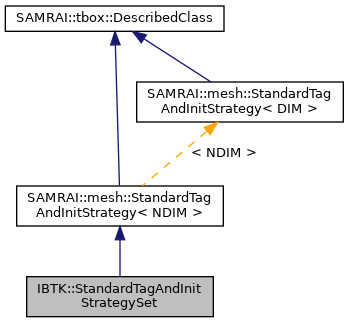
This class is primarily intended to provide a mechanism for allowing user-define tagging criteria.
- Note
- When the return value of a method is a timestep size, class StandardTagAndInitStrategySet returns the minimum timestep size computed by the collection of concrete SAMRAI::mesh::StandardTagAndInitStrategy objects. Consequently, user-defined tagging classes must provide implementations of getLevelDt() and advanceLevel() which return a large value such as MAX_DOUBLE as the timestep size.
- Warning
- Not all concrete implementations of class SAMRAI::mesh::StandardTagAndInitStrategy will work properly with class StandardTagAndInitStrategySet.
Advance data on all patches on specified patch level from current time (current_time) to new time (new_time). This routine is called only during time-dependent regridding procedures, such as Richardson extrapolation. It is virtual with an empty implementation here (rather than pure virtual) so that users are not required to provide an implementation when the function is not needed. The boolean arguments are used to determine the state of the algorithm and the data when the advance routine is called. Note that this advance function is also used during normal time integration steps.
When this function is called, the level data required to begin the advance must be allocated and be defined appropriately. Typically, this is equivalent to what is needed to initialize a new level after regridding. Upon exiting this routine, both current and new data may exist on the level. This data is needed until level synchronization occurs, in general. Current and new data may be reset by calling the member function resetTimeDependentData().
This routine is called from two different points within the Richardson extrapolation process: to advance a temporary level that is coarser than the hierarchy level on which error estimation is performed, and to advance the hierarchy level itself. In the first case, the values of the boolean flags are:
- first_step = true.
- last_step = true.
- regrid_advance = true.
In the second case, the values of the boolean flags are:
- first_step (when regridding during time integration sequence) = true when the level is not coarsest level to synchronize immediately before the regridding process; else, false. (when generating initial hierarchy construction) = true, even though there may be multiple advance steps.
- last_step = true when the advance is the last in the Richardson extrapolation step sequence; else false.
- regrid_advance = true.
Initialize data on a new level after it is inserted into an AMR patch hierarchy by the gridding algorithm. The level number indicates that of the new level.
Generally, when data is set, it is interpolated from coarser levels in the hierarchy. If the old level pointer in the argument list is non-null, then data is copied from the old level to the new level on regions of intersection between those levels before interpolation occurs. In this case, the level number must match that of the old level. The specific operations that occur when initializing level data are determined by the particular solution methods in use; i.e., in the subclass of this abstract base class.
The boolean argument initial_time indicates whether the level is being introduced for the first time (i.e., at initialization time), or after some regrid process during the calculation beyond the initial hierarchy construction. This information is provided since the initialization of the data may be different in each of those circumstances. The can_be_refined boolean argument indicates whether the level is the finest allowable level in the hierarchy.
After hierarchy levels have changed and data has been initialized on the new levels, this routine can be used to reset any information needed by the solution method that is particular to the hierarchy configuration. For example, the solution procedure may cache communication schedules to amortize the cost of data movement on the AMR patch hierarchy. This function will be called by the gridding algorithm after the initialization occurs so that the algorithm-specific subclass can reset such things. Also, if the solution method must make the solution consistent across multiple levels after the hierarchy is changed, this process may be invoked by this routine. Of course the details of these processes are determined by the particular solution methods in use.
The level number arguments indicate the coarsest and finest levels in the current hierarchy configuration that have changed. It should be assumed that all intermediate levels have changed as well.
Set integer tags to "one" in cells where refinement of the given level should occur according to some user-supplied gradient criteria. The double time argument is the regrid time. The integer "tag_index" argument is the patch descriptor index of the cell-centered integer tag array on each patch in the hierarchy. The boolean argument initial_time indicates whether the level is being subject to refinement at the initial simulation time. If it is false, then the error estimation process is being invoked at some later time after the AMR hierarchy was initially constructed. Typically, this information is passed to the user's patch tagging routines since the error estimator or gradient detector may be different in each case.
The boolean uses_richardson_extrapolation_too is true when Richardson extrapolation error estimation is used in addition to the gradient detector, and false otherwise. This argument helps the user to manage multiple regridding criteria.
| void IBTK::StandardTagAndInitStrategySet::applyRichardsonExtrapolation |
( |
SAMRAI::tbox::Pointer< SAMRAI::hier::PatchLevel< NDIM >> |
level, |
|
|
double |
error_data_time, |
|
|
int |
tag_index, |
|
|
double |
deltat, |
|
|
int |
error_coarsen_ratio, |
|
|
bool |
initial_time, |
|
|
bool |
uses_gradient_detector_too |
|
) |
| |
|
override |
Set integer tags to "one" in cells where refinement of the given level should occur according to some user-supplied Richardson extrapolation criteria. The "error_data_time" argument is the regrid time. The "deltat" argument is the time increment to advance the solution on the level to be refined. Note that that level is finer than the level in the argument list, in general. The ratio between the argument level and the actual hierarchy level is given by the integer "coarsen ratio".
The integer "tag_index" argument is the patch descriptor index of the cell-centered integer tag array on each patch in the hierarchy.
The boolean argument initial_time indicates whether the level is being subject to refinement at the initial simulation time. If it is false, then the error estimation process is being invoked at some later time after the AMR hierarchy was initially constructed. Typically, this information is passed to the user's patch tagging routines since the application of the Richardson extrapolation process may be different in each case.
The boolean uses_gradient_detector_too is true when a gradient detector procedure is used in addition to Richardson extrapolation, and false otherwise. This argument helps the user to manage multiple regridding criteria.
Advance data on all patches on specified patch level from current time (current_time) to new time (new_time). This routine is called only during time-dependent regridding procedures, such as Richardson extrapolation. It is virtual with an empty implementation here (rather than pure virtual) so that users are not required to provide an implementation when the function is not needed. The boolean arguments are used to determine the state of the algorithm and the data when the advance routine is called. Note that this advance function is also used during normal time integration steps.
When this function is called, the level data required to begin the advance must be allocated and be defined appropriately. Typically, this is equivalent to what is needed to initialize a new level after regridding. Upon exiting this routine, both current and new data may exist on the level. This data is needed until level synchronization occurs, in general. Current and new data may be reset by calling the member function resetTimeDependentData().
This routine is called from two different points within the Richardson exptrapolation process: to advance a temporary level that is coarser than the hierarchy level on which error estimation is performed, and to advance the hierarchy level itself. In the first case, the values of the boolean flags are:
- first_step = true.
- last_step = true.
- regrid_advance = true.
In the second case, the values of the boolean flags are:
- first_step (when regridding during time integration sequence) = true when the level is not coarsest level to synchronize immediately before the regridding process; else, false. (when generating initial hierarchy construction) = true, even though there may be multiple advance steps.
- last_step = true when the advance is the last in the Richardson extrapolation step sequence; else false.
- regrid_advance = true.
Initialize data on a new level after it is inserted into an AMR patch hierarchy by the gridding algorithm. The level number indicates that of the new level.
Generally, when data is set, it is interpolated from coarser levels in the hierarchy. If the old level pointer in the argument list is non-null, then data is copied from the old level to the new level on regions of intersection between those levels before interpolation occurs. In this case, the level number must match that of the old level. The specific operations that occur when initializing level data are determined by the particular solution methods in use; i.e., in the subclass of this abstract base class.
The boolean argument initial_time indicates whether the level is being introduced for the first time (i.e., at initialization time), or after some regrid process during the calculation beyond the initial hierarchy construction. This information is provided since the initialization of the data may be different in each of those circumstances. The can_be_refined boolean argument indicates whether the level is the finest allowable level in the hierarchy.
After hierarchy levels have changed and data has been initialized on the new levels, this routine can be used to reset any information needed by the solution method that is particular to the hierarchy configuration. For example, the solution procedure may cache communication schedules to amortize the cost of data movement on the AMR patch hierarchy. This function will be called by the gridding algorithm after the initialization occurs so that the algorithm-specific subclass can reset such things. Also, if the solution method must make the solution consistent across multiple levels after the hierarchy is changed, this process may be invoked by this routine. Of course the details of these processes are determined by the particular solution methods in use.
The level number arguments indicate the coarsest and finest levels in the current hierarchy configuration that have changed. It should be assumed that all intermediate levels have changed as well.
Set integer tags to "one" in cells where refinement of the given level should occur according to some user-supplied gradient criteria. The double time argument is the regrid time. The integer "tag_index" argument is the patch descriptor index of the cell-centered integer tag array on each patch in the hierarchy. The boolean argument initial_time indicates whether the level is being subject to refinement at the initial simulation time. If it is false, then the error estimation process is being invoked at some later time after the AMR hierarchy was initially constructed. Typically, this information is passed to the user's patch tagging routines since the error estimator or gradient detector may be different in each case.
The boolean uses_richardson_extrapolation_too is true when Richardson extrapolation error estimation is used in addition to the gradient detector, and false otherwise. This argument helps the user to manage multiple regridding criteria.
This routine is only when gradient detector is being used. It is virtual with an empty implementation here (rather than pure virtual) so that users are not required to provide an implementation when the function is not needed.
Set integer tags to "one" in cells where refinement of the given level should occur according to some user-supplied Richardson extrapolation criteria. The "error_data_time" argument is the regrid time. The "deltat" argument is the time increment to advance the solution on the level to be refined. Note that that level is finer than the level in the argument list, in general. The ratio between the argument level and the actual hierarchy level is given by the integer "coarsen ratio".
The integer "tag_index" argument is the patch descriptor index of the cell-centered integer tag array on each patch in the hierarchy.
The boolean argument initial_time indicates whether the level is being subject to refinement at the initial simulation time. If it is false, then the error estimation process is being invoked at some later time after the AMR hierarchy was initially constructed. Typically, this information is passed to the user's patch tagging routines since the application of the Richardson extrapolation process may be different in each case.
The boolean uses_gradient_detector_too is true when a gradient detector procedure is used in addition to Richardson extrapolation, and false otherwise. This argument helps the user to manage multiple regridding criteria.
This routine is only when Richardson extrapolation is being used. It is virtual with an empty implementation here (rather than pure virtual) so that users are not required to provide an implementation when the function is not needed.