#include <PatchEdgeDataNormOpsComplex.h>
Public Member Functions | |
| PatchEdgeDataNormOpsComplex () | |
| virtual | ~PatchEdgeDataNormOpsComplex () |
| int | numberOfEntries (const tbox::Pointer< pdat::EdgeData< DIM, dcomplex > > &data, const hier::Box< DIM > &box) const |
| double | sumControlVolumes (const tbox::Pointer< pdat::EdgeData< DIM, dcomplex > > &data, const tbox::Pointer< pdat::EdgeData< DIM, double > > &cvol, const hier::Box< DIM > &box) const |
| void | abs (tbox::Pointer< pdat::EdgeData< DIM, double > > &dst, const tbox::Pointer< pdat::EdgeData< DIM, dcomplex > > &src, const hier::Box< DIM > &box) const |
| double | L1Norm (const tbox::Pointer< pdat::EdgeData< DIM, dcomplex > > &data, const hier::Box< DIM > &box, const tbox::Pointer< pdat::EdgeData< DIM, double > > cvol=NULL) const |
| double | L2Norm (const tbox::Pointer< pdat::EdgeData< DIM, dcomplex > > &data, const hier::Box< DIM > &box, const tbox::Pointer< pdat::EdgeData< DIM, double > > cvol=NULL) const |
| double | weightedL2Norm (const tbox::Pointer< pdat::EdgeData< DIM, dcomplex > > &data, const tbox::Pointer< pdat::EdgeData< DIM, dcomplex > > &weight, const hier::Box< DIM > &box, const tbox::Pointer< pdat::EdgeData< DIM, double > > cvol=NULL) const |
| double | RMSNorm (const tbox::Pointer< pdat::EdgeData< DIM, dcomplex > > &data, const hier::Box< DIM > &box, const tbox::Pointer< pdat::EdgeData< DIM, double > > cvol=NULL) const |
| double | weightedRMSNorm (const tbox::Pointer< pdat::EdgeData< DIM, dcomplex > > &data, const tbox::Pointer< pdat::EdgeData< DIM, dcomplex > > &weight, const hier::Box< DIM > &box, const tbox::Pointer< pdat::EdgeData< DIM, double > > cvol=NULL) const |
| double | maxNorm (const tbox::Pointer< pdat::EdgeData< DIM, dcomplex > > &data, const hier::Box< DIM > &box, const tbox::Pointer< pdat::EdgeData< DIM, double > > cvol=NULL) const |
| dcomplex | dot (const tbox::Pointer< pdat::EdgeData< DIM, dcomplex > > &data1, const tbox::Pointer< pdat::EdgeData< DIM, dcomplex > > &data2, const hier::Box< DIM > &box, const tbox::Pointer< pdat::EdgeData< DIM, double > > cvol=NULL) const |
| dcomplex | integral (const tbox::Pointer< pdat::EdgeData< DIM, dcomplex > > &data, const hier::Box< DIM > &box, const tbox::Pointer< pdat::EdgeData< DIM, double > > vol) const |
Private Member Functions | |
| PatchEdgeDataNormOpsComplex (const PatchEdgeDataNormOpsComplex< DIM > &) | |
| void | operator= (const PatchEdgeDataNormOpsComplex< DIM > &) |
Private Attributes | |
| ArrayDataNormOpsComplex< DIM > | d_array_ops |
Detailed Description
template<int DIM>
class SAMRAI::math::PatchEdgeDataNormOpsComplex< DIM >
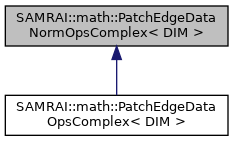
Class PatchEdgeDataNormOpsComplex<DIM> provides a collection of common norm operations that may be applied to complex edge-centered patch data.
The primary intent of this class is to define part of the interface for the PatchEdgeDataOpsComplex<DIM> class which provides access to operations that may be used to manipulate complex edge-centered patch data. Each member function accepts a box argument indicating the region of index space on which the operation should be performed. The operation will be performed on the intersection of this box and those boxes corresponding to the patch data objects. Also, each operation allows an additional edge-centered patch data object to be used to represent a control volume that weights the contribution of each data entry in the given norm calculation. Note that the control volume patch data must be of type double and have edge-centered geometry (i.e., the same as the data itself). The use of control volumes is important when these operations are used in vector kernels where the data resides over multiple levels of spatial resolution in an AMR hierarchy. If the control volume is not given in the function call, it will be ignored in the calculation. Also, note that the depth of the control volume patch data object must be either 1 or be equal to the depth of the other data objects.
Note that a similar set of norm operations is implemented for real patch data (double and float) in the class PatchEdgeDataNormOpsReal<DIM>.
- See also
- math::ArrayDataNormOpsComplex
Constructor & Destructor Documentation
◆ PatchEdgeDataNormOpsComplex() [1/2]
| SAMRAI::math::PatchEdgeDataNormOpsComplex< DIM >::PatchEdgeDataNormOpsComplex | ( | ) |
Empty constructor and destructor.
◆ ~PatchEdgeDataNormOpsComplex()
|
virtual |
◆ PatchEdgeDataNormOpsComplex() [2/2]
|
private |
Member Function Documentation
◆ numberOfEntries()
| int SAMRAI::math::PatchEdgeDataNormOpsComplex< DIM >::numberOfEntries | ( | const tbox::Pointer< pdat::EdgeData< DIM, dcomplex > > & | data, |
| const hier::Box< DIM > & | box | ||
| ) | const |
Return the number of data values for the edge-centered data object in the given box. Note that it is assumed that the box refers to the cell-centered index space corresponding to the patch hierarchy.
◆ sumControlVolumes()
| double SAMRAI::math::PatchEdgeDataNormOpsComplex< DIM >::sumControlVolumes | ( | const tbox::Pointer< pdat::EdgeData< DIM, dcomplex > > & | data, |
| const tbox::Pointer< pdat::EdgeData< DIM, double > > & | cvol, | ||
| const hier::Box< DIM > & | box | ||
| ) | const |
Return sum of control volume entries for the edge-centered data object.
◆ abs()
| void SAMRAI::math::PatchEdgeDataNormOpsComplex< DIM >::abs | ( | tbox::Pointer< pdat::EdgeData< DIM, double > > & | dst, |
| const tbox::Pointer< pdat::EdgeData< DIM, dcomplex > > & | src, | ||
| const hier::Box< DIM > & | box | ||
| ) | const |
Set destination component to norm of source component. That is, each destination entry is set to \(d_i = \sqrt{ {real(s_i)}^2 + {imag(s_i)}^2 }\).
◆ L1Norm()
| double SAMRAI::math::PatchEdgeDataNormOpsComplex< DIM >::L1Norm | ( | const tbox::Pointer< pdat::EdgeData< DIM, dcomplex > > & | data, |
| const hier::Box< DIM > & | box, | ||
| const tbox::Pointer< pdat::EdgeData< DIM, double > > | cvol = NULL |
||
| ) | const |
Return discrete \(L_1\)-norm of the data using the control volume to weight the contribution of each data entry to the sum. That is, the return value is the sum \(\sum_i ( \sqrt{data_i * \bar{data_i}}*cvol_i )\). If the control volume is NULL, the return value is \(\sum_i ( \sqrt{data_i * \bar{data_i}} )\).
◆ L2Norm()
| double SAMRAI::math::PatchEdgeDataNormOpsComplex< DIM >::L2Norm | ( | const tbox::Pointer< pdat::EdgeData< DIM, dcomplex > > & | data, |
| const hier::Box< DIM > & | box, | ||
| const tbox::Pointer< pdat::EdgeData< DIM, double > > | cvol = NULL |
||
| ) | const |
Return discrete \(L_2\)-norm of the data using the control volume to weight the contribution of each data entry to the sum. That is, the return value is the sum \(\sqrt{ \sum_i ( data_i * \bar{data_i} cvol_i ) }\). If the control volume is NULL, the return value is \(\sqrt{ \sum_i ( data_i * \bar{data_i} ) }\).
◆ weightedL2Norm()
| double SAMRAI::math::PatchEdgeDataNormOpsComplex< DIM >::weightedL2Norm | ( | const tbox::Pointer< pdat::EdgeData< DIM, dcomplex > > & | data, |
| const tbox::Pointer< pdat::EdgeData< DIM, dcomplex > > & | weight, | ||
| const hier::Box< DIM > & | box, | ||
| const tbox::Pointer< pdat::EdgeData< DIM, double > > | cvol = NULL |
||
| ) | const |
Return discrete weighted \(L_2\)-norm of the data using the control volume to weight the contribution of the data and weight entries to the sum. That is, the return value is the sum \(\sqrt{ \sum_i ( (data_i * wgt_i) * \bar{(data_i * wgt_i)} cvol_i ) }\). If the control volume is NULL, the return value is \(\sqrt{ \sum_i ( (data_i * wgt_i) * \bar{(data_i * wgt_i)} cvol_i ) }\).
◆ RMSNorm()
| double SAMRAI::math::PatchEdgeDataNormOpsComplex< DIM >::RMSNorm | ( | const tbox::Pointer< pdat::EdgeData< DIM, dcomplex > > & | data, |
| const hier::Box< DIM > & | box, | ||
| const tbox::Pointer< pdat::EdgeData< DIM, double > > | cvol = NULL |
||
| ) | const |
Return discrete root mean squared norm of the data. If the control volume is not NULL, the return value is the \(L_2\)-norm divided by the square root of the sum of the control volumes. Otherwise, the return value is the \(L_2\)-norm divided by the square root of the number of data entries.
◆ weightedRMSNorm()
| double SAMRAI::math::PatchEdgeDataNormOpsComplex< DIM >::weightedRMSNorm | ( | const tbox::Pointer< pdat::EdgeData< DIM, dcomplex > > & | data, |
| const tbox::Pointer< pdat::EdgeData< DIM, dcomplex > > & | weight, | ||
| const hier::Box< DIM > & | box, | ||
| const tbox::Pointer< pdat::EdgeData< DIM, double > > | cvol = NULL |
||
| ) | const |
Return discrete weighted root mean squared norm of the data. If the control volume is not NULL, the return value is the weighted \(L_2\)-norm divided by the square root of the sum of the control volumes. Otherwise, the return value is the weighted \(L_2\)-norm divided by the square root of the number of data entries.
◆ maxNorm()
| double SAMRAI::math::PatchEdgeDataNormOpsComplex< DIM >::maxNorm | ( | const tbox::Pointer< pdat::EdgeData< DIM, dcomplex > > & | data, |
| const hier::Box< DIM > & | box, | ||
| const tbox::Pointer< pdat::EdgeData< DIM, double > > | cvol = NULL |
||
| ) | const |
Return the \(\max\)-norm of the data using the control volume to weight the contribution of each data entry to the maximum. That is, the return value is \(\max_i ( \sqrt{data_i * \bar{data_i}} )\), where the max is over the data elements where \(cvol_i > 0\). If the control volume is NULL, it is ignored during the computation of the maximum.
◆ dot()
| dcomplex SAMRAI::math::PatchEdgeDataNormOpsComplex< DIM >::dot | ( | const tbox::Pointer< pdat::EdgeData< DIM, dcomplex > > & | data1, |
| const tbox::Pointer< pdat::EdgeData< DIM, dcomplex > > & | data2, | ||
| const hier::Box< DIM > & | box, | ||
| const tbox::Pointer< pdat::EdgeData< DIM, double > > | cvol = NULL |
||
| ) | const |
Return the dot product of the two data arrays using the control volume to weight the contribution of each product to the sum. That is, the return value is the sum \(\sum_i ( data1_i * \bar{data2_i} * cvol_i )\). If the control volume is NULL, it is ignored during the summation.
◆ integral()
| dcomplex SAMRAI::math::PatchEdgeDataNormOpsComplex< DIM >::integral | ( | const tbox::Pointer< pdat::EdgeData< DIM, dcomplex > > & | data, |
| const hier::Box< DIM > & | box, | ||
| const tbox::Pointer< pdat::EdgeData< DIM, double > > | vol | ||
| ) | const |
Return the integral of the function represented by the data array. The return value is the sum \(\sum_i ( data_i * vol_i )\).
◆ operator=()
|
private |
Member Data Documentation
◆ d_array_ops
|
private |
The documentation for this class was generated from the following file:
- /samrai/include/PatchEdgeDataNormOpsComplex.h