#include <CellIndex.h>
Public Member Functions | |
| CellIndex () | |
| CellIndex (const hier::Index< DIM > &rhs) | |
| CellIndex (const CellIndex< DIM > &rhs) | |
| CellIndex< DIM > & | operator= (const CellIndex< DIM > &rhs) |
| CellIndex< DIM > & | operator+= (const hier::IntVector< DIM > &rhs) |
| CellIndex< DIM > | operator+ (const hier::IntVector< DIM > &rhs) const |
| CellIndex< DIM > & | operator+= (const int rhs) |
| CellIndex< DIM > | operator+ (const int rhs) const |
| CellIndex< DIM > & | operator-= (const hier::IntVector< DIM > &rhs) |
| CellIndex< DIM > | operator- (const hier::IntVector< DIM > &rhs) const |
| CellIndex< DIM > & | operator-= (const int rhs) |
| CellIndex< DIM > | operator- (const int rhs) const |
| CellIndex< DIM > & | operator*= (const hier::IntVector< DIM > &rhs) |
| CellIndex< DIM > | operator* (const hier::IntVector< DIM > &rhs) const |
| CellIndex< DIM > & | operator*= (const int rhs) |
| CellIndex< DIM > | operator* (const int rhs) const |
| bool | operator== (const CellIndex< DIM > &rhs) const |
| bool | operator!= (const CellIndex< DIM > &rhs) const |
| Index< DIM > & | operator+= (const IntVector< DIM > &rhs) |
| Index< DIM > | operator+ (const IntVector< DIM > &rhs) const |
| Index< DIM > & | operator-= (const IntVector< DIM > &rhs) |
| Index< DIM > | operator- (const IntVector< DIM > &rhs) const |
| IntVector< DIM > | operator- () const |
| Index< DIM > & | operator*= (const IntVector< DIM > &rhs) |
| Index< DIM > | operator* (const IntVector< DIM > &rhs) const |
| Index< DIM > & | operator/= (const IntVector< DIM > &rhs) |
| Index< DIM > & | operator/= (const int rhs) |
| Index< DIM > | operator/ (const IntVector< DIM > &rhs) const |
| Index< DIM > | operator/ (const int rhs) const |
| int & | operator() (const int i) |
| const int & | operator() (const int i) const |
| operator int * () | |
| operator const int * () const | |
| bool | operator== (const IntVector< DIM > &rhs) const |
| bool | operator!= (const IntVector< DIM > &rhs) const |
| bool | operator< (const IntVector< DIM > &rhs) const |
| bool | operator<= (const IntVector< DIM > &rhs) const |
| bool | operator> (const IntVector< DIM > &rhs) const |
| bool | operator>= (const IntVector< DIM > &rhs) const |
| void | min (const IntVector< DIM > &rhs) |
| int | min () const |
| void | max (const IntVector< DIM > &rhs) |
| int | max () const |
| int | getProduct () const |
Static Public Member Functions | |
| static IntVector< DIM > | min (const IntVector< DIM > &a, const IntVector< DIM > &b) |
| static IntVector< DIM > | max (const IntVector< DIM > &a, const IntVector< DIM > &b) |
Private Attributes | |
| int | d_vector [DIM] |
Detailed Description
template<int DIM>
class SAMRAI::pdat::CellIndex< DIM >
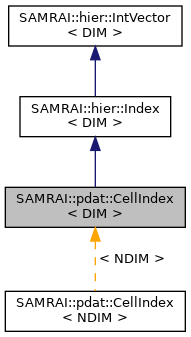
Class CellIndex<DIM> implements a simple n-dimensional integer vector for cell centered variables. Cell indices contain an integer index location in AMR index space and are identical to the AMR indices.
Constructor & Destructor Documentation
◆ CellIndex() [1/3]
| SAMRAI::pdat::CellIndex< DIM >::CellIndex | ( | ) |
The default constructor for a cell index creates an uninitialized index.
◆ CellIndex() [2/3]
| SAMRAI::pdat::CellIndex< DIM >::CellIndex | ( | const hier::Index< DIM > & | rhs | ) |
Construct a cell index from a regular AMR index.
◆ CellIndex() [3/3]
| SAMRAI::pdat::CellIndex< DIM >::CellIndex | ( | const CellIndex< DIM > & | rhs | ) |
The copy constructor creates a cell index equal to the argument.
Member Function Documentation
◆ operator=()
| CellIndex<DIM>& SAMRAI::pdat::CellIndex< DIM >::operator= | ( | const CellIndex< DIM > & | rhs | ) |
The assignment operator sets the cell index equal to the argument.
◆ operator+=() [1/3]
| CellIndex<DIM>& SAMRAI::pdat::CellIndex< DIM >::operator+= | ( | const hier::IntVector< DIM > & | rhs | ) |
Plus-equals operator for a cell index and an integer vector.
◆ operator+() [1/3]
| CellIndex<DIM> SAMRAI::pdat::CellIndex< DIM >::operator+ | ( | const hier::IntVector< DIM > & | rhs | ) | const |
Plus operator for a cell index and an integer vector.
◆ operator+=() [2/3]
| CellIndex<DIM>& SAMRAI::pdat::CellIndex< DIM >::operator+= | ( | const int | rhs | ) |
Plus-equals operator for a cell index and an integer.
◆ operator+() [2/3]
| CellIndex<DIM> SAMRAI::pdat::CellIndex< DIM >::operator+ | ( | const int | rhs | ) | const |
Plus operator for a cell index and an integer.
◆ operator-=() [1/3]
| CellIndex<DIM>& SAMRAI::pdat::CellIndex< DIM >::operator-= | ( | const hier::IntVector< DIM > & | rhs | ) |
Minus-equals operator for a cell index and an integer vector.
◆ operator-() [1/4]
| CellIndex<DIM> SAMRAI::pdat::CellIndex< DIM >::operator- | ( | const hier::IntVector< DIM > & | rhs | ) | const |
Minus operator for a cell index and an integer vector.
◆ operator-=() [2/3]
| CellIndex<DIM>& SAMRAI::pdat::CellIndex< DIM >::operator-= | ( | const int | rhs | ) |
Minus-equals operator for a cell index and an integer.
◆ operator-() [2/4]
| CellIndex<DIM> SAMRAI::pdat::CellIndex< DIM >::operator- | ( | const int | rhs | ) | const |
Minus operator for a cell index and an integer.
◆ operator*=() [1/3]
| CellIndex<DIM>& SAMRAI::pdat::CellIndex< DIM >::operator*= | ( | const hier::IntVector< DIM > & | rhs | ) |
Times-equals operator for a cell index and an integer vector.
◆ operator*() [1/3]
| CellIndex<DIM> SAMRAI::pdat::CellIndex< DIM >::operator* | ( | const hier::IntVector< DIM > & | rhs | ) | const |
Times operator for a cell index and an integer vector.
◆ operator*=() [2/3]
| CellIndex<DIM>& SAMRAI::pdat::CellIndex< DIM >::operator*= | ( | const int | rhs | ) |
Times-equals operator for a cell index and an integer.
◆ operator*() [2/3]
| CellIndex<DIM> SAMRAI::pdat::CellIndex< DIM >::operator* | ( | const int | rhs | ) | const |
Times operator for a cell index and an integer.
◆ operator==() [1/2]
| bool SAMRAI::pdat::CellIndex< DIM >::operator== | ( | const CellIndex< DIM > & | rhs | ) | const |
Returns true if two cell index objects are equal. All components must be the same for equality.
◆ operator!=() [1/2]
| bool SAMRAI::pdat::CellIndex< DIM >::operator!= | ( | const CellIndex< DIM > & | rhs | ) | const |
Returns true if two cell index objects are not equal. Any of the components may be different for inequality.
◆ operator+=() [3/3]
|
inherited |
Plus-equals operator for an index and an integer vector.
◆ operator+() [3/3]
|
inherited |
Plus operator for an index and an integer vector.
◆ operator-=() [3/3]
|
inherited |
Minus-equals operator for an index and an integer vector.
◆ operator-() [3/4]
|
inherited |
Minus operator for an index and an integer vector.
◆ operator-() [4/4]
|
inherited |
Unary minus to negate an integer vector.
◆ operator*=() [3/3]
|
inherited |
Times-equals operator for an index and an integer vector.
◆ operator*() [3/3]
|
inherited |
Times operator for an index and an integer vector.
◆ operator/=() [1/2]
|
inherited |
Assign-quotient operator for an index and an integer vector.
◆ operator/=() [2/2]
|
inherited |
Assign-quotient operator for an index and an integer.
◆ operator/() [1/2]
|
inherited |
Quotient operator for an index and an integer vector.
◆ operator/() [2/2]
|
inherited |
Quotient operator for an index and an integer.
◆ operator()() [1/2]
|
inherited |
Return the specified component of the vector. No bounds checking.
◆ operator()() [2/2]
|
inherited |
Return the specified component of the vector as a const integer. No bounds checking.
◆ operator int *()
|
inherited |
Return a pointer to the beginning of the vector data values.
◆ operator const int *()
|
inherited |
Return a const pointer to the beginning of the vector data values.
◆ operator==() [2/2]
|
inherited |
Returns true if two vector objects are equal. All components must be the same for equality.
◆ operator!=() [2/2]
|
inherited |
Returns true if two vector objects are not equal. Any of the components may be different for inequality.
◆ operator<()
|
inherited |
Returns true if each integer in vector is less than corresponding integer in comparison vector.
◆ operator<=()
|
inherited |
Returns true if each integer in vector is less or equal to corresponding integer in comparison vector.
◆ operator>()
|
inherited |
Returns true if each integer in vector is greater than corresponding integer in comparison vector.
◆ operator>=()
|
inherited |
Returns true if each integer in vector is greater or equal to corresponding integer in comparison vector.
◆ min() [1/3]
|
inherited |
Return the component-wise minimum of two integer vector objects.
◆ min() [2/3]
|
inherited |
Return the minimum entry in an integer vector.
◆ min() [3/3]
|
staticinherited |
Utility function to take the minimum of two integer vector objects.
◆ max() [1/3]
|
inherited |
Return the component-wise maximum of two integer vector objects.
◆ max() [2/3]
|
inherited |
Return the maximum entry in an integer vector.
◆ max() [3/3]
|
staticinherited |
Utility function to take the maximum of two integer vector objects.
◆ getProduct()
|
inherited |
Return the product of the entries in the integer vector.
Member Data Documentation
◆ d_vector
|
privateinherited |
The documentation for this class was generated from the following file:
- /samrai/include/CellIndex.h