#include <NodeIndex.h>
Public Types | |
| enum | Corner { Left = 0 , Right = 1 , LowerLeft = 0 , LowerRight = 1 , UpperLeft = 2 , UpperRight = 3 , LLL = 0 , ULL = 1 , LUL = 2 , UUL = 3 , LLU = 4 , ULU = 5 , LUU = 6 , UUU = 7 } |
Public Member Functions | |
| NodeIndex () | |
| NodeIndex (const hier::Index< DIM > &rhs, const Corner corner) | |
| NodeIndex (const hier::Index< DIM > &rhs, const hier::IntVector< DIM > &corner) | |
| NodeIndex (const NodeIndex< DIM > &rhs) | |
| NodeIndex< DIM > & | operator= (const NodeIndex< DIM > &rhs) |
| NodeIndex< DIM > & | operator+= (const hier::IntVector< DIM > &rhs) |
| NodeIndex< DIM > | operator+ (const hier::IntVector< DIM > &rhs) const |
| NodeIndex< DIM > & | operator+= (const int rhs) |
| NodeIndex< DIM > | operator+ (const int rhs) const |
| NodeIndex< DIM > & | operator-= (const hier::IntVector< DIM > &rhs) |
| NodeIndex< DIM > | operator- (const hier::IntVector< DIM > &rhs) const |
| NodeIndex< DIM > & | operator-= (const int rhs) |
| NodeIndex< DIM > | operator- (const int rhs) const |
| NodeIndex< DIM > & | operator*= (const hier::IntVector< DIM > &rhs) |
| NodeIndex< DIM > | operator* (const hier::IntVector< DIM > &rhs) const |
| NodeIndex< DIM > & | operator*= (const int rhs) |
| NodeIndex< DIM > | operator* (const int rhs) const |
| bool | operator== (const NodeIndex< DIM > &rhs) const |
| bool | operator!= (const NodeIndex< DIM > &rhs) const |
| Index< DIM > & | operator+= (const IntVector< DIM > &rhs) |
| Index< DIM > | operator+ (const IntVector< DIM > &rhs) const |
| Index< DIM > & | operator-= (const IntVector< DIM > &rhs) |
| Index< DIM > | operator- (const IntVector< DIM > &rhs) const |
| IntVector< DIM > | operator- () const |
| Index< DIM > & | operator*= (const IntVector< DIM > &rhs) |
| Index< DIM > | operator* (const IntVector< DIM > &rhs) const |
| Index< DIM > & | operator/= (const IntVector< DIM > &rhs) |
| Index< DIM > & | operator/= (const int rhs) |
| Index< DIM > | operator/ (const IntVector< DIM > &rhs) const |
| Index< DIM > | operator/ (const int rhs) const |
| int & | operator() (const int i) |
| const int & | operator() (const int i) const |
| operator int * () | |
| operator const int * () const | |
| bool | operator== (const IntVector< DIM > &rhs) const |
| bool | operator!= (const IntVector< DIM > &rhs) const |
| bool | operator< (const IntVector< DIM > &rhs) const |
| bool | operator<= (const IntVector< DIM > &rhs) const |
| bool | operator> (const IntVector< DIM > &rhs) const |
| bool | operator>= (const IntVector< DIM > &rhs) const |
| void | min (const IntVector< DIM > &rhs) |
| int | min () const |
| void | max (const IntVector< DIM > &rhs) |
| int | max () const |
| int | getProduct () const |
Static Public Member Functions | |
| static IntVector< DIM > | min (const IntVector< DIM > &a, const IntVector< DIM > &b) |
| static IntVector< DIM > | max (const IntVector< DIM > &a, const IntVector< DIM > &b) |
Private Member Functions | |
| void | setOffsets () |
Private Attributes | |
| int | d_vector [DIM] |
Static Private Attributes | |
| static hier::IntVector< DIM > | s_offsets [2<< DIM] |
| static bool | s_offsets_are_set |
Detailed Description
template<int DIM>
class SAMRAI::pdat::NodeIndex< DIM >
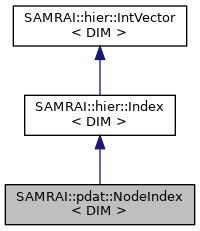
Class NodeIndex<DIM> implements a simple n-dimensional integer vector for node centered variables. Given a hier::Box in the AMR abstract index space, the index space for a node-centered variable runs from the lower corner of the box to the upper corner of the box plus one in each dimension. See the node box geometry class for more information about the mapping between the AMR index space and the node indices.
Member Enumeration Documentation
◆ Corner
| enum SAMRAI::pdat::NodeIndex::Corner |
The Corner enumerated type is used when converting from a cell centered index to a node centered index. In 1d, use Left and Right. In 2d, use LowerLeft, LowerRight, UpperLeft, and UpperRight. In 3d, the naming is less intuitive, and use names LLL through UUU, where L means lower and U means upper. Therefore, to get the box upper in X, lower in Y, and lower in Z, use corner name ULL.
| Enumerator | |
|---|---|
| Left | |
| Right | |
| LowerLeft | |
| LowerRight | |
| UpperLeft | |
| UpperRight | |
| LLL | |
| ULL | |
| LUL | |
| UUL | |
| LLU | |
| ULU | |
| LUU | |
| UUU | |
Constructor & Destructor Documentation
◆ NodeIndex() [1/4]
| SAMRAI::pdat::NodeIndex< DIM >::NodeIndex | ( | ) |
The default constructor for a node index creates an uninitialized index.
◆ NodeIndex() [2/4]
| SAMRAI::pdat::NodeIndex< DIM >::NodeIndex | ( | const hier::Index< DIM > & | rhs, |
| const Corner | corner | ||
| ) |
Construct a node index from a regular index and a corner.
The Corner enumerated type is only defined for 3D or lower, so use the next constructor with an hier::IntVector argument when using higher dimensions.
◆ NodeIndex() [3/4]
| SAMRAI::pdat::NodeIndex< DIM >::NodeIndex | ( | const hier::Index< DIM > & | rhs, |
| const hier::IntVector< DIM > & | corner | ||
| ) |
Construct a node index from a regular index and an hier::IntVector. The hier::IntVector is binary–an assertion failure will result if it contains any values other than 0 or 1. For each dimension, if the hier::IntVector contains a 0, the node index will represent a lower bound in that dimensional direction, and if 1 will represent an upper bound in that direction.
◆ NodeIndex() [4/4]
| SAMRAI::pdat::NodeIndex< DIM >::NodeIndex | ( | const NodeIndex< DIM > & | rhs | ) |
The copy constructor creates a node index equal to the argument.
Member Function Documentation
◆ operator=()
| NodeIndex<DIM>& SAMRAI::pdat::NodeIndex< DIM >::operator= | ( | const NodeIndex< DIM > & | rhs | ) |
The assignment operator sets the node index equal to the argument.
◆ operator+=() [1/3]
| NodeIndex<DIM>& SAMRAI::pdat::NodeIndex< DIM >::operator+= | ( | const hier::IntVector< DIM > & | rhs | ) |
Plus-equals operator for a node index and an integer vector.
◆ operator+() [1/3]
| NodeIndex<DIM> SAMRAI::pdat::NodeIndex< DIM >::operator+ | ( | const hier::IntVector< DIM > & | rhs | ) | const |
Plus operator for a node index and an integer vector.
◆ operator+=() [2/3]
| NodeIndex<DIM>& SAMRAI::pdat::NodeIndex< DIM >::operator+= | ( | const int | rhs | ) |
Plus-equals operator for a node index and an integer.
◆ operator+() [2/3]
| NodeIndex<DIM> SAMRAI::pdat::NodeIndex< DIM >::operator+ | ( | const int | rhs | ) | const |
Plus operator for a node index and an integer.
◆ operator-=() [1/3]
| NodeIndex<DIM>& SAMRAI::pdat::NodeIndex< DIM >::operator-= | ( | const hier::IntVector< DIM > & | rhs | ) |
Minus-equals operator for a node index and an integer vector.
◆ operator-() [1/4]
| NodeIndex<DIM> SAMRAI::pdat::NodeIndex< DIM >::operator- | ( | const hier::IntVector< DIM > & | rhs | ) | const |
Minus operator for a node index and an integer vector.
◆ operator-=() [2/3]
| NodeIndex<DIM>& SAMRAI::pdat::NodeIndex< DIM >::operator-= | ( | const int | rhs | ) |
Minus-equals operator for a node index and an integer.
◆ operator-() [2/4]
| NodeIndex<DIM> SAMRAI::pdat::NodeIndex< DIM >::operator- | ( | const int | rhs | ) | const |
Minus operator for a node index and an integer.
◆ operator*=() [1/3]
| NodeIndex<DIM>& SAMRAI::pdat::NodeIndex< DIM >::operator*= | ( | const hier::IntVector< DIM > & | rhs | ) |
Times-equals operator for a node index and an integer vector.
◆ operator*() [1/3]
| NodeIndex<DIM> SAMRAI::pdat::NodeIndex< DIM >::operator* | ( | const hier::IntVector< DIM > & | rhs | ) | const |
Times operator for a node index and an integer vector.
◆ operator*=() [2/3]
| NodeIndex<DIM>& SAMRAI::pdat::NodeIndex< DIM >::operator*= | ( | const int | rhs | ) |
Times-equals operator for a node index and an integer.
◆ operator*() [2/3]
| NodeIndex<DIM> SAMRAI::pdat::NodeIndex< DIM >::operator* | ( | const int | rhs | ) | const |
Times operator for a node index and an integer.
◆ operator==() [1/2]
| bool SAMRAI::pdat::NodeIndex< DIM >::operator== | ( | const NodeIndex< DIM > & | rhs | ) | const |
Returns true if two node index objects are equal. All components must be the same for equality.
◆ operator!=() [1/2]
| bool SAMRAI::pdat::NodeIndex< DIM >::operator!= | ( | const NodeIndex< DIM > & | rhs | ) | const |
Returns true if two node index objects are not equal. Any of the components may be different for inequality.
◆ setOffsets()
|
private |
◆ operator+=() [3/3]
|
inherited |
Plus-equals operator for an index and an integer vector.
◆ operator+() [3/3]
|
inherited |
Plus operator for an index and an integer vector.
◆ operator-=() [3/3]
|
inherited |
Minus-equals operator for an index and an integer vector.
◆ operator-() [3/4]
|
inherited |
Minus operator for an index and an integer vector.
◆ operator-() [4/4]
|
inherited |
Unary minus to negate an integer vector.
◆ operator*=() [3/3]
|
inherited |
Times-equals operator for an index and an integer vector.
◆ operator*() [3/3]
|
inherited |
Times operator for an index and an integer vector.
◆ operator/=() [1/2]
|
inherited |
Assign-quotient operator for an index and an integer vector.
◆ operator/=() [2/2]
|
inherited |
Assign-quotient operator for an index and an integer.
◆ operator/() [1/2]
|
inherited |
Quotient operator for an index and an integer vector.
◆ operator/() [2/2]
|
inherited |
Quotient operator for an index and an integer.
◆ operator()() [1/2]
|
inherited |
Return the specified component of the vector. No bounds checking.
◆ operator()() [2/2]
|
inherited |
Return the specified component of the vector as a const integer. No bounds checking.
◆ operator int *()
|
inherited |
Return a pointer to the beginning of the vector data values.
◆ operator const int *()
|
inherited |
Return a const pointer to the beginning of the vector data values.
◆ operator==() [2/2]
|
inherited |
Returns true if two vector objects are equal. All components must be the same for equality.
◆ operator!=() [2/2]
|
inherited |
Returns true if two vector objects are not equal. Any of the components may be different for inequality.
◆ operator<()
|
inherited |
Returns true if each integer in vector is less than corresponding integer in comparison vector.
◆ operator<=()
|
inherited |
Returns true if each integer in vector is less or equal to corresponding integer in comparison vector.
◆ operator>()
|
inherited |
Returns true if each integer in vector is greater than corresponding integer in comparison vector.
◆ operator>=()
|
inherited |
Returns true if each integer in vector is greater or equal to corresponding integer in comparison vector.
◆ min() [1/3]
|
inherited |
Return the component-wise minimum of two integer vector objects.
◆ min() [2/3]
|
inherited |
Return the minimum entry in an integer vector.
◆ min() [3/3]
|
staticinherited |
Utility function to take the minimum of two integer vector objects.
◆ max() [1/3]
|
inherited |
Return the component-wise maximum of two integer vector objects.
◆ max() [2/3]
|
inherited |
Return the maximum entry in an integer vector.
◆ max() [3/3]
|
staticinherited |
Utility function to take the maximum of two integer vector objects.
◆ getProduct()
|
inherited |
Return the product of the entries in the integer vector.
Member Data Documentation
◆ s_offsets
|
staticprivate |
◆ s_offsets_are_set
|
staticprivate |
◆ d_vector
|
privateinherited |
The documentation for this class was generated from the following file:
- /samrai/include/NodeIndex.h