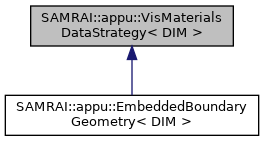
Class VisMaterialsDataStrategy<DIM> is an abstract base class that defines an interface allowing an VisItDataWriter<DIM> object to generate plot files that contain material and species fractions, as well as state variables for individual materials. A concrete object of this type must be registered with the data writer in order to use materials or species with the data writer. The registration of the concrete object is done using the method setMaterialsDataWriter() from the VisItDataWriter class. VisIt requires that material fractions, species fractions, and material state variables be cell-centered. If they are not cell-centered in the simulation, it is the job of the relevant packing method to convert them to a cell-centered basis before packing them into the buffer. More...
#include <VisMaterialsDataStrategy.h>
Public Types | |
| enum | PACK_RETURN_TYPE { VISIT_ALLZERO = 0 , VISIT_ALLONE = 1 , VISIT_MIXED = 2 } |
| Enumerated type for the allowable return values for packMaterialFractionsIntoDoubleBuffer() and packSpeciesFractionsIntoDoubleBuffer(). More... | |
Public Member Functions | |
| VisMaterialsDataStrategy () | |
| Default constructor for VisMaterialsDataStrategy<DIM>. More... | |
| virtual | ~VisMaterialsDataStrategy () |
| Destructor for VisMaterialsDataStrategy<DIM>. More... | |
| virtual int | packMaterialFractionsIntoDoubleBuffer (double *buffer, const hier::Patch< DIM > &patch, const hier::Box< DIM > ®ion, const std::string &material_name) const |
| This function, which must be implemented whenever materials are used, packs cell-centered material fractions for the given material, patch, and region into the given 1D double precision buffer which will already have been allocated. If a non-zero ghost cell vector was specified when registerMaterialNames() was invoked, then ghost data corresponding to this ghost cell vector must be packed into this double buffer. The data must be packed into the buffer in column major order, i.e. (f(x_0,y_0,z_0), f(x_1,y_0,z_0), f(x_2,y_0,z_0), ...). More... | |
| virtual int | packMaterialFractionsIntoSparseBuffers (int *mat_list, std::vector< int > &mix_zones, std::vector< int > &mix_mat, std::vector< double > &vol_fracs, std::vector< int > &next_mat, const hier::Patch< DIM > &patch, const hier::Box< DIM > ®ion) const |
| Pack sparse volume fraction data. More... | |
| virtual int | packSpeciesFractionsIntoDoubleBuffer (double *buffer, const hier::Patch< DIM > &patch, const hier::Box< DIM > ®ion, const std::string &material_name, const std::string &species_name) const |
| This function packs cell-centered species fractions for the given species. More... | |
Detailed Description
template<int DIM>
class SAMRAI::appu::VisMaterialsDataStrategy< DIM >
The concrete strategy object is responsible for supplying an implementation of packMaterialFractionsIntoDoubleBuffer(). If species are used, packSpeciesFractionsIntoDoubleBuffer() must also be implemented. If material state variables are used, packMaterialStateVariableIntoDoubleBuffer() must be implemented.
- See also
- appu::VisItDataWriter
Member Enumeration Documentation
◆ PACK_RETURN_TYPE
| enum SAMRAI::appu::VisMaterialsDataStrategy::PACK_RETURN_TYPE |
Constructor & Destructor Documentation
◆ VisMaterialsDataStrategy()
| SAMRAI::appu::VisMaterialsDataStrategy< DIM >::VisMaterialsDataStrategy | ( | ) |
◆ ~VisMaterialsDataStrategy()
|
virtual |
Member Function Documentation
◆ packMaterialFractionsIntoDoubleBuffer()
|
virtual |
This method will be called once for each material for each patch.
A enumerated PACK_RETURN_TYPE is used for a return value. To save space in the visit data file, you may choose to set the return value to indicate if a material does not exist at all on the patch, or if the material exists fully on the patch. A return of ALL_ZERO indicates there is 0% of the material in each of the cells of the patch, while a return type of ALL_ONE indicates the material consumes 100% on each of the cells of the patch. If the patch has a mixture of the material (i.e. between 0% and 100%) then return MIXTURE.
- Parameters
-
buffer Double precision array into which cell-centered material fractions are packed. patch hier::Patch on which fractions are defined. region hier::Box region over which to pack fractions. material_name String identifier for the material.
- Returns
- The enumeration constant VisMaterialsDataStrategy::ALL_ZERO, VisMaterialsDataStrategy::ALL_ONE, or VisMaterialsDataStrategy::MIXTURE.
Reimplemented in SAMRAI::appu::EmbeddedBoundaryGeometry< DIM >.
◆ packMaterialFractionsIntoSparseBuffers()
|
virtual |
This function, which must be implemented whenever materials are used if the sparse packing format is to be used. Packing traverses the patch in a column major order (i.e. (f(x_0,y_0,z_0), f(x_1,y_0,z_0), f(x_2,y_0,z_0), ...) ). If the current cell is clean, then the material number of the material occupying the cell should be packed in to the buffer. If the cell is mixed, then a negative index (i.e., with numbering begining at -1) into the auxilliary mix_zones, mix_mat, vol_fracs, and next_mat vectors which will contain the sparse representation of the volume fractions (VisIt will correct the negative index internally and offset to a zero based representation). For each component of a mixed cell packMaterialFractionsIntoDoubleBuffer() should pack an entry in the following vectors: mix_zones: the cell number with which the fraction is associated mix_mat: the material number of the fraction vol_fracs: the volume fraction of the current material next_mat: either the (positive but still offset by one) index to the next mixed component within the auxilliary vectors or a 0, indicating the end of the mixed components for this cell.
If a non-zero ghost cell vector was specified when registerMaterialNames() was invoked, then ghost data corresponding to this ghost cell vector must be packed into this double buffer.
This method will be called once for each patch.
A enumerated PACK_RETURN_TYPE is used for a return value. To save space in the visit data file, you may choose to set the return value to ALL_ONE to indicate that a single material occupies 100% of each cell on the patch. Otherwise, MIXTURE should be returned even if individual cells are not mixed, as this indicates that the patch contains multiple materials.
- Parameters
-
buffer Double precision array into which the material numbers (or negative indices) are packed. mix_zones std::vector<int> into which the cell number associated with the mixed components are packed. mix_mat std::vector<int> into which the material numbers of the mixed components are packed. vol_fracs std::vector<double> into which the volume fractions (between 0.0 and 1.0) of the mixed components are packed. next_mat std::vector<int> into which the (positive) index of the next mixed component or a terminating 0 are packed. patch hier::Patch on which fractions are defined. region hier::Box region over which to pack fractions.
- Returns
- The enumeration constant VisMaterialsDataStrategy::ALL_ONE, or VisMaterialsDataStrategy::MIXTURE.
◆ packSpeciesFractionsIntoDoubleBuffer()
|
virtual |
This user supplied function packs species fractions of the given material, patch, and region into the supplied 1D double precision buffer. If a non-zero ghost cell vector was specified when registerSpeciesNames() was invoked, then ghost data corresponding to this ghost cell vector must be packed into this double buffer. The data must be packed into the buffer in column major order.
This method will be called once for each species for each patch.
The method must return a PACK_RETURN_TYPE of ALL_ONE, ALL_ZERO, or MIXED. See the discussion above for the "packMaterialFractionsIntoDoubleBuffer()" method for an explanation of correct return values.
- Parameters
-
buffer Double precision array into which cell-centered species fractions are packed. patch hier::Patch on which fractions are defined. region hier::Box region over which to pack fractions. material_name String identifier for the material to which the species belongs. species_name String identifier for the species.
- Returns
- The enumeration constant VisMaterialsDataStrategy::ALL_ZERO, VisMaterialsDataStrategy::ALL_ONE, or VisMaterialsDataStrategy::MIXTURE.
The documentation for this class was generated from the following file:
- /samrai/include/VisMaterialsDataStrategy.h