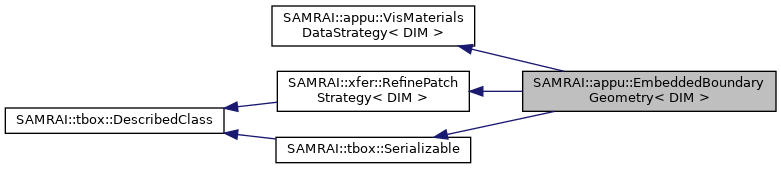
Class EmbeddedBoundaryGeometry provides embedded boundary mesh construction, storage, and management on an AMR hierarchy.
More...
#include <EmbeddedBoundaryGeometry.h>
Public Types | |
| enum | CELL_TYPE { SOLID = EmbeddedBoundaryDefines::SOLID , CUT = EmbeddedBoundaryDefines::CUT , BORDER = EmbeddedBoundaryDefines::BORDER , FLOW = EmbeddedBoundaryDefines::FLOW } |
| enum | NODE_TYPE { OUTSIDE = EmbeddedBoundaryDefines::OUTSIDE , INSIDE = EmbeddedBoundaryDefines::INSIDE , BOUNDARY = EmbeddedBoundaryDefines::BOUNDARY , ONBOUNDARY = EmbeddedBoundaryDefines::ONBOUNDARY } |
| enum | PACK_RETURN_TYPE { VISIT_ALLZERO = 0 , VISIT_ALLONE = 1 , VISIT_MIXED = 2 } |
| Enumerated type for the allowable return values for packMaterialFractionsIntoDoubleBuffer() and packSpeciesFractionsIntoDoubleBuffer(). More... | |
Public Member Functions | |
| EmbeddedBoundaryGeometry (const std::string &object_name, tbox::Pointer< tbox::Database > input_db=NULL, const tbox::Pointer< geom::CartesianGridGeometry< DIM > > grid_geom=NULL, const hier::IntVector< DIM > &nghosts=hier::IntVector< DIM >(0)) | |
| ~EmbeddedBoundaryGeometry () | |
| void | buildEmbeddedBoundaryOnLevel (const tbox::Pointer< hier::PatchLevel< DIM > > level, const tbox::Pointer< hier::PatchHierarchy< DIM > > hierarchy=NULL, const tbox::Pointer< hier::PatchLevel< DIM > > old_level=NULL) |
| void | tagInsideOutsideNodesOnLevel (const tbox::Pointer< hier::PatchLevel< DIM > > level) |
| void | registerVisItDataWriter (tbox::Pointer< appu::VisItDataWriter< DIM > > visit_writer) |
| int | getCellFlagDataId () const |
| int | getCellVolumeDataId () const |
| int | getIndexCutCellDataId () const |
| int | getNodeInsideOutsideDataId () const |
| double | computeTotalVolumeOnLevel (const tbox::Pointer< hier::PatchLevel< DIM > > level) |
| void | setGridGeometry (const tbox::Pointer< geom::CartesianGridGeometry< DIM > > grid_geom) |
| void | writeLevelEmbeddedBoundaryDataToFile (const tbox::Pointer< hier::PatchLevel< DIM > > level, const std::string &dirname) const |
| int | packMaterialFractionsIntoDoubleBuffer (double *dbuffer, const hier::Patch< DIM > &patch, const hier::Box< DIM > ®ion, const std::string &material_name) const |
| void | setPhysicalBoundaryConditions (hier::Patch< DIM > &patch, const double fill_time, const hier::IntVector< DIM > &ghost_width_to_fill) |
| virtual void | preprocessRefine (hier::Patch< DIM > &fine, const hier::Patch< DIM > &coarse, const hier::Box< DIM > &fine_box, const hier::IntVector< DIM > &ratio) |
| virtual void | postprocessRefine (hier::Patch< DIM > &fine, const hier::Patch< DIM > &coarse, const hier::Box< DIM > &fine_box, const hier::IntVector< DIM > &ratio) |
| virtual hier::IntVector< DIM > | getRefineOpStencilWidth () const |
| void | putToDatabase (tbox::Pointer< tbox::Database > db) |
| virtual int | packMaterialFractionsIntoSparseBuffers (int *mat_list, std::vector< int > &mix_zones, std::vector< int > &mix_mat, std::vector< double > &vol_fracs, std::vector< int > &next_mat, const hier::Patch< DIM > &patch, const hier::Box< DIM > ®ion) const |
| Pack sparse volume fraction data. More... | |
| virtual int | packSpeciesFractionsIntoDoubleBuffer (double *buffer, const hier::Patch< DIM > &patch, const hier::Box< DIM > ®ion, const std::string &material_name, const std::string &species_name) const |
| This function packs cell-centered species fractions for the given species. More... | |
| virtual void | preprocessRefineBoxes (hier::Patch< DIM > &fine, const hier::Patch< DIM > &coarse, const hier::BoxList< DIM > &fine_boxes, const hier::IntVector< DIM > &ratio) |
| virtual void | postprocessRefineBoxes (hier::Patch< DIM > &fine, const hier::Patch< DIM > &coarse, const hier::BoxList< DIM > &fine_boxes, const hier::IntVector< DIM > &ratio) |
Private Member Functions | |
| void | initializeVariables (const hier::IntVector< DIM > &nghosts) |
| void | computeEmbeddedBoundaryOnLevelWithPackage (const tbox::Pointer< hier::PatchLevel< DIM > > level, int &cut_cells_on_level) |
| void | computeEmbeddedBoundaryOnLevel (const tbox::Pointer< hier::PatchLevel< DIM > > level, int &cut_cells_on_level, double &l2_volume_error, double &l2_area_error, double &max_volume_error, double &max_area_error) |
| void | calculateCutCellInformation (appu::CutCell< DIM > &cut_cell, const double *lower, const double *upper, const double &fullcellvol, const double *fullareas, double &volume_error_estimate, double &area_error_estimate) |
| void | calculateBoundaryNodeInformation (appu::CutCell< DIM > &cut_cell, tbox::Pointer< pdat::NodeData< DIM, int > > &node_flag, const double *lower, const double *upper, const double *dx) |
| double | calculateVolume (const double *cell_lower, const double *cell_upper, double &error_estimate) const |
| int | recursiveCalculateVolume (const double *cell_lower, const double *cell_upper, double &volume, double &error_estimate, int &subdivide_level) const |
| double | calculateArea (const double *cell_lower, const double *cell_upper, const int face, double &error_estimate) const |
| int | recursiveCalculateArea (const double *cell_lower, const double *cell_upper, const int face, double &area, double &error_estimate, int &subdivide_level) const |
| int | classifyCell (const double *lower, const double *upper) const |
| void | refineEmbeddedBoundary (const tbox::Pointer< hier::PatchLevel< DIM > > level, const tbox::Pointer< hier::PatchLevel< DIM > > old_level=NULL, const tbox::Pointer< hier::PatchHierarchy< DIM > > hierarchy=NULL) |
| void | setEmbeddedBoundaryAtPhysicalBoundaries (const tbox::Pointer< hier::PatchLevel< DIM > > level) |
| void | setLevelRatioInformation (const tbox::Pointer< hier::PatchLevel< DIM > > level) |
| void | doNativeShapeInsideOutside (const int *nx, const double *dx, const double *origin, int *node_flag) const |
| void | readLevelEmbeddedBoundaryDataFromFile (const tbox::Pointer< hier::PatchLevel< DIM > > level, const std::string &dirname) const |
| void | getFromInput (tbox::Pointer< tbox::Database > db, const bool is_from_restart) |
| void | getFromRestart () |
Detailed Description
template<int DIM>
class SAMRAI::appu::EmbeddedBoundaryGeometry< DIM >
The embedded boundary may be constructed from a set of analytic shapes supplied through input. The following outlines the steps required:
- Construct an EmbeddedBoundaryGeometry object, supplying the input file that contains the shape entries, a pointer to the Cartesian grid geometry, and the desired number of ghosts to be used in defining the embedded boundary:
*    EmbeddedBoundaryGeometry* eb_geom =
*       new EmbeddedBoundaryGeometry("EmbeddedBoundaryGeometry",
*                                     input_db->getDatabase("EBdryGeometry"),
*                                     grid_geometry,
*                                     nghosts);
*
Note: The cart_grid_geometry argument is optional and may be supplied later using the "setGridGeometry()" method. However, it must be set before the "buildEmbeddedBoundaryOnLevel()" is called. The nghosts argument is also optional and is set to zero by default.
- Build the embedded boundary on the levels of the hierarchy:
*    Pointer<PatchLevel<DIM> > level = hierarchy->getPatchLevel(ln);
*    eb_geom->buildEmbeddedBoundaryOnLevel(level);
*
Note: It is also possible to pass in a hierarchy and an old level as arguments. If supplied, this information can be used to accelerate construction of the boundary on the supplied level.
- Access information about the embedded boundary from patches:
- The "cell flag" identifies whether a cell is cut, solid, or flow
- The "node flag" identifies nodes as inside, outside, boundary (first node just inside solid boundary), or on-boundary (within a specified distance from the solid boundary).
- The "volume fraction" will be 0.0 for solid cells, 1.0 for flow cells, and somewhere in-between for cut cells
- The list of "cut cells" holds information about the normal, face areas, etc. on specific cells that are cut.
*    int cell_flag_index = eb_geom->getCellFlagDataId();
*    int node_flag_index = eb_geom->getNodeInsideOutsideDataId();
*    int vol_frac_index = eb_geom->getCellVolumeDataId();
*    int cut_cell_index = eb_geom->getIndexCutCellDataId();
*
*    tbox::Pointer<CellData<DIM,int> > cell_flag_data =
*        patch->getPatchData(cell_flag_index);
*    tbox::Pointer<NodeData<DIM,int> > node_flag_data =
*        patch->getPatchData(node_flag_index);
*    tbox::Pointer<CellData<DIM,double> > vol_frac_data =
*        patch->getPatchData(vol_frac_index);
*    tbox::Pointer<IndexData<DIM,CutCell> > cut_cell_data =
*        patch->getPatchData(cut_cell_index);
*
Input parameters specify the list of shapes to be used to construct the boundary, the desired accuracy of the volume and area fraction computation, and information about whether write constructed embedded boundary information to file, or read from file.
Required input keys and data types: NONE
Optional input keys, data types, and defaults:
-verbose boolean specifying whether to output information about the embedded boundary, such as the number of cut cells, the error in the volume calculation, etc. to the log file. If no value is supplied in input, the default is TRUE.
-max_subdivides
integer specifying the number of cell subdivides when computing the volume and area fractions. The larger the number of subdivides, the more accurate the fraction calculation will be, but the calculation will also be more expensive. If no value is supplied in input, a default of 0 is used.
-read_from_file bool specifying whether to read the embedded boundary from file.
If true, it will read flag, volume fraction, and cut cell information describing the embedded boundary from the specified HDF "dirname" (specified below). If no value is supplied, the default is FALSE.
-write_to_file bool specifying whether to write the embedded boundary to the specified HDF "dirname" (specified below). If true, it will write flag, volume fraction, and cut cell information computed while building the embedded boundary to the specified HDF "dirname" (specified below). If no value is supplied, the default is FALSE.
-dirname string specifying the name of the HDF directory to read/write embedded boundary information. Used with the "read_from_file" and "write_to_file" options.
-compute_areas_and_normal
bool specifying whether to compute areas and normal information.
Some applications only need the volume fraction so it is not necessary to invoke the extra cost of computing the areas and normal. If no value is supplied, the default is TRUE.
-compute_cutcell_index_data bool specifying whether to compute a list of cut cells. If false, it will compute the cell flag and volume fraction information but will not create and store the list of CutCell data structs. If no value is supplied, the default is TRUE.
-compute_boundary_node_data bool specifying whether to mark nodes that are just inside the geometry as BOUNDARY nodes, and to compute the centroid of the wetted cut area (i.e. the "front area") of the cut cells. This information may be needed for node-based finite difference or finite element computations of the embedded boundary. If no value is supplied, the default is TRUE.
-use_recursive_algs bool specifying whether to use a recursive algorithm to compute volume and area fractions. If true, it volume and area fractions are computed by recursively subdividing the cell until the max number of subdivides is reached. If false, it will apply the max subdivides to divide the cell into a (potentially large) array of subcells. Algorithmically, the recursive algorithm has fewer operations but the non-recursive algorithm may be more computationally efficient because it can do array-based operations. If no value is supplied, the default is TRUE.
-Shapes sub-database that specifies information about the analytic shapes used to construct an embedded boundary. See the EmbeddedBoundaryShapeSphere and EmbeddedBoundaryShapePolygon class headers for information on the inputs required.
-CubesPatchInterface sub-database for the Cubes interface, a cut-cell mesh generator from NASA Ames. See the CubesPatchInterface class header for information about the required inputs.
The following represents a sample input entry:
*  EmbeddedBoundaryGeometry{
*     max_subdivides = 2
*     read_from_file  = FALSE
*     write_to_file   = FALSE
*     dirname         = "eb_grid"
*     compute_areas_and_normal   = TRUE
*     compute_boundary_node_data = FALSE
*     use_recursive_algs         = FALSE
*
*     Shapes {
*        Shape1 {
*           type = "POLYGON"
*           vertices {
*              v1 = 1.0 , 1.0
*              v2 = 1.5 , .5
*              v3 = 2.0 , 1.75
*              v4 = 1.5 , 4.5
*              v5 = .5 , 2.0
*           }
*           height = 5.0 // only used for 3D
*        }
*        Shape2 {
*           type = "SPHERE"
*           center = 65., 50.
*           radius = 20.
*        }
*     }
*  }
*
Note: Each shape has its own specific set of inputs. See the individual shapes for information about input requirements.
Member Enumeration Documentation
◆ CELL_TYPE
| enum SAMRAI::appu::EmbeddedBoundaryGeometry::CELL_TYPE |
Enumerated type for the different cell classifications.
- SOLID {Cell is located in the "solid" region.}
- CUT {Cell is cut, meaning a CutCell data structure will be maintained at this cell.}
- BORDER {Cell neighbors a cut cell, in the "flow" region.}
- FLOW {Cell is located in the "flow" region.}
| Enumerator | |
|---|---|
| SOLID | |
| CUT | |
| BORDER | |
| FLOW | |
◆ NODE_TYPE
| enum SAMRAI::appu::EmbeddedBoundaryGeometry::NODE_TYPE |
Enumerated type for inside/outside node classification.
- INSIDE {Node is located "inside" the prescribed geometry.}
- OUTSIDE {Node is outside the geometry.}
- BOUNDARY {Node is on the boundary of the geometry. That is it is the first one "inside" the geometry.}
- ONBOUNDARY {Node is located exactly on the boundary of the geometry (used to avoid divide-by-zero problems) in numerical operations at embedded boundary.}
| Enumerator | |
|---|---|
| OUTSIDE | |
| INSIDE | |
| BOUNDARY | |
| ONBOUNDARY | |
◆ PACK_RETURN_TYPE
|
inherited |
Constructor & Destructor Documentation
◆ EmbeddedBoundaryGeometry()
| SAMRAI::appu::EmbeddedBoundaryGeometry< DIM >::EmbeddedBoundaryGeometry | ( | const std::string & | object_name, |
| tbox::Pointer< tbox::Database > | input_db = NULL, |
||
| const tbox::Pointer< geom::CartesianGridGeometry< DIM > > | grid_geom = NULL, |
||
| const hier::IntVector< DIM > & | nghosts = hier::IntVector< DIM >(0) |
||
| ) |
Constructor sets default values and reads data from input.
- Parameters
-
object_name Name of object. input_db Input database. grid_geom The grid geometry (e.g. cartesian) used in the problem. nghosts Number of ghosts used to hold the embedded boundary. If not supplied, defaults to 0.
The grid_geom and nghosts may be NULL if the embedded boundary information is to be supplied by a file, either by restart or by other input such as CART3D. If the embedded boundary is to be constructed using analytic shapes in SAMRAI, the input_db and and grid_geom arguments must be supplied and may not be NULL.
◆ ~EmbeddedBoundaryGeometry()
| SAMRAI::appu::EmbeddedBoundaryGeometry< DIM >::~EmbeddedBoundaryGeometry | ( | ) |
Destructor deallocates data describing and unregisters the object with the restart manager if previously registered.
Member Function Documentation
◆ buildEmbeddedBoundaryOnLevel()
| void SAMRAI::appu::EmbeddedBoundaryGeometry< DIM >::buildEmbeddedBoundaryOnLevel | ( | const tbox::Pointer< hier::PatchLevel< DIM > > | level, |
| const tbox::Pointer< hier::PatchHierarchy< DIM > > | hierarchy = NULL, |
||
| const tbox::Pointer< hier::PatchLevel< DIM > > | old_level = NULL |
||
| ) |
Build an embedded boundary by forming the set of cut cells, extend them to appropriately apply the physical boundary conditions, and lastly compute the surrounding volumes for mass correction.
Depending on the arguments supplied, this method may be used in one of two ways. The first, taking only the level as an argument, performs an exhaustive search of all cells on the level to find the cut cells and classify the cells as inside or outside.
The second, taking as additional arguments a hierarchy, coarser_level, and possibly old_level, performs the same function but uses the information on the coarser and old levels to narrow the search for cut cells, making it considerably faster. Generally, the first method is used for the coarsest level only and the second is used for all subsequent finer levels.
- Parameters
-
level Patch level on which embedded boundary is to be constructed. hierarchy Patch hierarchy of the level. Required if the level supplied in the first argument is in the hierarchy and is not the coarsest level. old_level Patch level which holds "old" embedded boundary data (not required). Use this if regridding and you have an embedded boundary at the old level to speed construction of the boundary on the new level.
◆ tagInsideOutsideNodesOnLevel()
| void SAMRAI::appu::EmbeddedBoundaryGeometry< DIM >::tagInsideOutsideNodesOnLevel | ( | const tbox::Pointer< hier::PatchLevel< DIM > > | level | ) |
Tag nodes as being inside or outside the geometry. Some applications only require this knowledge and do not use need the volume/area fraction information for cut cells.
- Parameters
-
level Patch level where tagging takes place.
◆ registerVisItDataWriter()
| void SAMRAI::appu::EmbeddedBoundaryGeometry< DIM >::registerVisItDataWriter | ( | tbox::Pointer< appu::VisItDataWriter< DIM > > | visit_writer | ) |
Register a VisIt data writer so this class will write plot files that may be postprocessed with the VisIt visualization tool.
- Parameters
-
visit_writer VisIt data writer
◆ getCellFlagDataId()
| int SAMRAI::appu::EmbeddedBoundaryGeometry< DIM >::getCellFlagDataId | ( | ) | const |
Return the descriptor index for the CellData<DIM,int> patch data that holds the integer flag at each cell, identifying it as being solid, cut, boundary, or flow.
◆ getCellVolumeDataId()
| int SAMRAI::appu::EmbeddedBoundaryGeometry< DIM >::getCellVolumeDataId | ( | ) | const |
Return the descriptor index for the CellData<DIM,double> patch data that holds the cell volume fraction.
◆ getIndexCutCellDataId()
| int SAMRAI::appu::EmbeddedBoundaryGeometry< DIM >::getIndexCutCellDataId | ( | ) | const |
Return the descriptor index for the IndexData<DIM,CutCell> patch data that holds the list of embedded boundary cells on the patch.
◆ getNodeInsideOutsideDataId()
| int SAMRAI::appu::EmbeddedBoundaryGeometry< DIM >::getNodeInsideOutsideDataId | ( | ) | const |
Return the descriptor index for the NodeData<DIM,int> patch data that specifies a cell as being inside or outside the geometry.
◆ computeTotalVolumeOnLevel()
| double SAMRAI::appu::EmbeddedBoundaryGeometry< DIM >::computeTotalVolumeOnLevel | ( | const tbox::Pointer< hier::PatchLevel< DIM > > | level | ) |
Compute the total volume, which is the sum of the volume fractions, on the supplied level.
◆ setGridGeometry()
| void SAMRAI::appu::EmbeddedBoundaryGeometry< DIM >::setGridGeometry | ( | const tbox::Pointer< geom::CartesianGridGeometry< DIM > > | grid_geom | ) |
Set the grid geometry, if it was not supplied when the object was constructed.
◆ writeLevelEmbeddedBoundaryDataToFile()
| void SAMRAI::appu::EmbeddedBoundaryGeometry< DIM >::writeLevelEmbeddedBoundaryDataToFile | ( | const tbox::Pointer< hier::PatchLevel< DIM > > | level, |
| const std::string & | dirname | ||
| ) | const |
Write embedded boundary information - cell flag and cut cell information - to supplied directory. Files of the form "ebmesh-l<ln>-p<pid>.hdf", where ln is the level number and pid is the processor number, will be written to the directory.
◆ packMaterialFractionsIntoDoubleBuffer()
|
virtual |
The following routine:
packMaterialFractionsIntoDoubleBuffer()
is a concrete implementation of function declared in the appu::VisMaterialsDataStrategy abstract base class.
Put volume data located on the patch into the double buffer over the specified region.
- Parameters
-
dbuffer double buffer into which materials data is packed. patch supplied patch on which materials data is defined region region over which data is packed material_name name of the material
Reimplemented from SAMRAI::appu::VisMaterialsDataStrategy< DIM >.
◆ setPhysicalBoundaryConditions()
|
virtual |
The following routines:
setPhysicalBoundaryConditions(),
getRefineOpStencilWidth(),
postprocessRefine()
are concrete implementations of functions declared in the xfer::RefinePatchStrategy abstract base class.
Set the data in ghost cells corresponding to physical boundary conditions. Specific boundary conditions are determined by information specified in input file and numerical routines.
Implements SAMRAI::xfer::RefinePatchStrategy< DIM >.
◆ preprocessRefine()
|
inlinevirtual |
Perform user-defined refining operations. This member function is called before the other refining operators. For this class, no preprocessing is needed for the refine operators so it is setup to do nothing.
Implements SAMRAI::xfer::RefinePatchStrategy< DIM >.
◆ postprocessRefine()
|
virtual |
Postprocess data after the refinement operator is applied. For the embedded boundary data, refining involves two steps; First, refine the "flag" data, which will designate on the fine level where the boundary exists; Second, on each fine cell that is flagged to possibly contain the boundary, go through and determine whether the cell is indeed cut by the boundary and adjust the volume, flag, and boundary cell data on the fine level as necessary. This method invokes step 2 of this refine operation.
Implements SAMRAI::xfer::RefinePatchStrategy< DIM >.
◆ getRefineOpStencilWidth()
|
virtual |
Return maximum stencil width needed for user-defined data interpolation operations. Default is to return zero, assuming no user-defined operations provided.
Implements SAMRAI::xfer::RefinePatchStrategy< DIM >.
◆ putToDatabase()
|
virtual |
The following routine:
putToDatabase()
is a concrete implementation of a function declared in the tbox::Serializable abstract base class.
Implements SAMRAI::tbox::Serializable.
◆ initializeVariables()
|
private |
◆ computeEmbeddedBoundaryOnLevelWithPackage()
|
private |
◆ computeEmbeddedBoundaryOnLevel()
|
private |
◆ calculateCutCellInformation()
|
private |
◆ calculateBoundaryNodeInformation()
|
private |
◆ calculateVolume()
|
private |
◆ recursiveCalculateVolume()
|
private |
◆ calculateArea()
|
private |
◆ recursiveCalculateArea()
|
private |
◆ classifyCell()
|
private |
◆ refineEmbeddedBoundary()
|
private |
◆ setEmbeddedBoundaryAtPhysicalBoundaries()
|
private |
Set the embedded boundary cells on physical boundarys according to the specified boundary conditions.
◆ setLevelRatioInformation()
|
private |
◆ doNativeShapeInsideOutside()
|
private |
◆ readLevelEmbeddedBoundaryDataFromFile()
|
private |
Read embedded boundary information - cell flag and cut cell information - from supplied directory. Files of the form "ebmesh-l<ln>-p<pid>.hdf", where ln is the level number and pid is the processor number, should exist in the directory. If they don't exist, an error will be thrown.
◆ getFromInput()
|
private |
◆ getFromRestart()
|
private |
◆ packMaterialFractionsIntoSparseBuffers()
|
virtualinherited |
This function, which must be implemented whenever materials are used if the sparse packing format is to be used. Packing traverses the patch in a column major order (i.e. (f(x_0,y_0,z_0), f(x_1,y_0,z_0), f(x_2,y_0,z_0), ...) ). If the current cell is clean, then the material number of the material occupying the cell should be packed in to the buffer. If the cell is mixed, then a negative index (i.e., with numbering begining at -1) into the auxilliary mix_zones, mix_mat, vol_fracs, and next_mat vectors which will contain the sparse representation of the volume fractions (VisIt will correct the negative index internally and offset to a zero based representation). For each component of a mixed cell packMaterialFractionsIntoDoubleBuffer() should pack an entry in the following vectors: mix_zones: the cell number with which the fraction is associated mix_mat: the material number of the fraction vol_fracs: the volume fraction of the current material next_mat: either the (positive but still offset by one) index to the next mixed component within the auxilliary vectors or a 0, indicating the end of the mixed components for this cell.
If a non-zero ghost cell vector was specified when registerMaterialNames() was invoked, then ghost data corresponding to this ghost cell vector must be packed into this double buffer.
This method will be called once for each patch.
A enumerated PACK_RETURN_TYPE is used for a return value. To save space in the visit data file, you may choose to set the return value to ALL_ONE to indicate that a single material occupies 100% of each cell on the patch. Otherwise, MIXTURE should be returned even if individual cells are not mixed, as this indicates that the patch contains multiple materials.
- Parameters
-
buffer Double precision array into which the material numbers (or negative indices) are packed. mix_zones std::vector<int> into which the cell number associated with the mixed components are packed. mix_mat std::vector<int> into which the material numbers of the mixed components are packed. vol_fracs std::vector<double> into which the volume fractions (between 0.0 and 1.0) of the mixed components are packed. next_mat std::vector<int> into which the (positive) index of the next mixed component or a terminating 0 are packed. patch hier::Patch on which fractions are defined. region hier::Box region over which to pack fractions.
- Returns
- The enumeration constant VisMaterialsDataStrategy::ALL_ONE, or VisMaterialsDataStrategy::MIXTURE.
◆ packSpeciesFractionsIntoDoubleBuffer()
|
virtualinherited |
This user supplied function packs species fractions of the given material, patch, and region into the supplied 1D double precision buffer. If a non-zero ghost cell vector was specified when registerSpeciesNames() was invoked, then ghost data corresponding to this ghost cell vector must be packed into this double buffer. The data must be packed into the buffer in column major order.
This method will be called once for each species for each patch.
The method must return a PACK_RETURN_TYPE of ALL_ONE, ALL_ZERO, or MIXED. See the discussion above for the "packMaterialFractionsIntoDoubleBuffer()" method for an explanation of correct return values.
- Parameters
-
buffer Double precision array into which cell-centered species fractions are packed. patch hier::Patch on which fractions are defined. region hier::Box region over which to pack fractions. material_name String identifier for the material to which the species belongs. species_name String identifier for the species.
- Returns
- The enumeration constant VisMaterialsDataStrategy::ALL_ZERO, VisMaterialsDataStrategy::ALL_ONE, or VisMaterialsDataStrategy::MIXTURE.
◆ preprocessRefineBoxes()
|
virtualinherited |
Virtual function to perform user-defined refine operations. This member function is called before standard refining operations (expressed using concrete subclasses of the RefineOperator<DIM> base class). The preprocess function must refine data from the scratch components of the coarse patch into the scratch components of the fine patch on the specified fine box regions.
Typically, only the pure virtual members of this class are implemented in user-defined subclasses of this base class. This version of the preprocess function operates on an entire box list. By default, this version simply loops over the box list and calls the single-box version, which is a pure virtual function.
- Parameters
-
fine Fine patch containing destination data. coarse Coarse patch containing source data. fine_boxes tbox::List of box regions on fine patch into which data is refined. ratio Integer vector containing ratio relating index space between coarse and fine patches.
Reimplemented in SAMRAI::solv::CartesianRobinBcHelper< DIM >.
◆ postprocessRefineBoxes()
|
virtualinherited |
Virtual function to perform user-defined refine operations. This member function is called after standard refining operations (expressed using concrete subclasses of the RefineOperator<DIM> base class). The postprocess function must refine data from the scratch components of the coarse patch into the scratch components of the fine patch on the specified fine box regions.
Typically, only the pure virtual members of this class are implemented in user-defined subclasses of this base class. This version of the postprocess function operates on an entire box list. By default, this version simply loops over the box list and calls the single-box version, which is a pure virtual function.
- Parameters
-
fine Fine patch containing destination data. coarse Coarse patch containing source data. fine_boxes tbox::List of box regions on fine patch into which data is refined. ratio Integer vector containing ratio relating index space between coarse and fine patches.
Reimplemented in SAMRAI::solv::CartesianRobinBcHelper< DIM >.
Member Data Documentation
◆ d_object_name
|
private |
◆ d_grid_geometry
|
private |
◆ d_visit_writer
|
private |
◆ d_verbose
|
private |
◆ d_flow_type
|
private |
◆ d_ebdry_nghosts
|
private |
◆ d_ebdry_var
|
private |
◆ d_cell_flag_var
|
private |
◆ d_cell_vol_var
|
private |
◆ d_node_flag_var
|
private |
◆ d_ebdry_data_id
|
private |
◆ d_ebdry_scratch_id
|
private |
◆ d_cell_flag_data_id
|
private |
◆ d_cell_flag_scratch_id
|
private |
◆ d_cell_vol_data_id
|
private |
◆ d_cell_vol_scratch_id
|
private |
◆ d_node_flag_data_id
|
private |
◆ d_ebdry_refine_alg
|
private |
◆ d_max_levels
|
private |
◆ d_ratio_to_coarser
|
private |
◆ d_level_ratios
|
private |
◆ d_use_cubes
|
private |
◆ d_cubes_interface
|
private |
◆ d_use_eleven_inside_outside
|
private |
◆ d_use_eleven_boundary_node
|
private |
◆ d_eleven_interface
|
private |
◆ d_shapes
|
private |
◆ d_max_subdivides
|
private |
◆ d_read_ebdry
|
private |
◆ d_write_ebdry
|
private |
◆ d_ebdry_dirname
|
private |
◆ d_use_recursive_algs
|
private |
◆ d_compute_areas_and_normal
|
private |
◆ d_compute_cutcell_index_data
|
private |
◆ d_compute_boundary_node_data
|
private |
◆ d_node_bdry_cond
|
private |
◆ d_edge_bdry_cond
|
private |
◆ d_face_bdry_cond
|
private |
◆ t_compute_eb
|
private |
◆ t_calc_node_inout
|
private |
◆ t_calc_volume
|
private |
◆ t_calc_area
|
private |
◆ t_calc_boundary_node
|
private |
◆ t_eb_phys_bdry
|
private |
◆ t_read_write_eb
|
private |
◆ d_step_count
|
private |
The documentation for this class was generated from the following file:
- /samrai/include/EmbeddedBoundaryGeometry.h