#include <SkeletonGridGeometry.h>
Public Member Functions | |
| SkeletonGridGeometry (const std::string &object_name, tbox::Pointer< tbox::Database > input_db, bool register_for_restart=true) | |
| SkeletonGridGeometry (const std::string &object_name, const hier::BoxArray< DIM > &level_domain, bool register_for_restart=true) | |
| virtual | ~SkeletonGridGeometry () |
| tbox::Pointer< hier::GridGeometry< DIM > > | makeRefinedGridGeometry (const std::string &fine_geom_name, const hier::IntVector< DIM > &refine_ratio, bool register_for_restart) const |
| tbox::Pointer< hier::GridGeometry< DIM > > | makeCoarsenedGridGeometry (const std::string &coarse_geom_name, const hier::IntVector< DIM > &coarsen_ratio, bool register_for_restart) const |
| void | setGeometryDataOnPatch (hier::Patch< DIM > &patch, const hier::IntVector< DIM > &ratio_to_level_zero, const tbox::Array< tbox::Array< bool > > &touches_regular_bdry, const tbox::Array< tbox::Array< bool > > &touches_periodic_bdry) const |
| virtual void | printClassData (std::ostream &os) const |
| virtual void | putToDatabase (tbox::Pointer< tbox::Database > db) |
| virtual void | addSpatialCoarsenOperator (tbox::Pointer< CoarsenOperator< DIM > > coarsen_op) |
| virtual void | addSpatialRefineOperator (tbox::Pointer< RefineOperator< DIM > > refine_op) |
| virtual void | addTimeInterpolateOperator (tbox::Pointer< TimeInterpolateOperator< DIM > > time_op) |
| virtual tbox::Pointer< CoarsenOperator< DIM > > | lookupCoarsenOperator (const tbox::Pointer< hier::Variable< DIM > > &var, const std::string &op_name) const |
| virtual tbox::Pointer< RefineOperator< DIM > > | lookupRefineOperator (const tbox::Pointer< hier::Variable< DIM > > &var, const std::string &op_name) const |
| virtual tbox::Pointer< TimeInterpolateOperator< DIM > > | lookupTimeInterpolateOperator (const tbox::Pointer< hier::Variable< DIM > > &var, const std::string &op_name="STD_LINEAR_TIME_INTERPOLATE") const |
Private Member Functions | |
| void | getFromInput (tbox::Pointer< tbox::Database > db, bool is_from_restart) |
| void | getFromRestart () |
| void | makeStandardOperators () |
Private Attributes | |
| std::string | d_object_name |
| bool | d_registered_for_restart |
| bool | d_using_original_locations |
| tbox::List< tbox::Pointer< CoarsenOperator< DIM > > > | d_coarsen_operators |
| tbox::List< tbox::Pointer< RefineOperator< DIM > > > | d_refine_operators |
| tbox::List< tbox::Pointer< TimeInterpolateOperator< DIM > > > | d_time_operators |
Functions for computing boundary boxes | |
| BoxArray< DIM > | d_physical_domain |
| bool | d_domain_is_single_box |
| IntVector< DIM > | d_periodic_shift |
| IntVector< DIM > | d_max_data_ghost_width |
| void | findPatchesTouchingBoundaries (tbox::Array< tbox::Array< tbox::Array< bool > > > &touches_regular_bdry, tbox::Array< tbox::Array< tbox::Array< bool > > > &touches_periodic_bdry, const PatchLevel< DIM > &level, const IntVector< DIM > &periodic_shift, const BoxArray< DIM > &domain) const |
| Determine for every patch on a level if it touches a regular physical boundary or a periodic boundary. More... | |
| virtual void | setGeometryOnPatches (hier::PatchLevel< DIM > &level, const hier::IntVector< DIM > &ratio_to_level_zero, tbox::Array< tbox::Array< tbox::Array< bool > > > &touches_regular_bdry, tbox::Array< tbox::Array< tbox::Array< bool > > > &touches_periodic_bdry, bool defer_boundary_box_creation) |
| Pass the arrays holding the boundary information to be stored in the concrete geometry classes, and construct boundary boxes if required. More... | |
| void | setBoundaryBoxes (hier::PatchLevel< DIM > &level) |
| Construct the boundary boxes for each patch and set them on the patch geometries. More... | |
| void | computeShiftsForLevel (tbox::Array< tbox::List< IntVector< DIM > > > &shifts, const PatchLevel< DIM > &level, const BoxArray< DIM > &physical_domain) const |
| void | computePhysicalDomain (BoxArray< DIM > &domain, const IntVector< DIM > &ratio_to_level_zero) const |
| void | setPhysicalDomain (const BoxArray< DIM > &domain) |
| const BoxArray< DIM > & | getPhysicalDomain () const |
| bool | getDomainIsSingleBox () const |
| void | initializePeriodicShift (const IntVector< DIM > &directions) |
| IntVector< DIM > | getPeriodicShift (const IntVector< DIM > &ratio_to_level_zero=IntVector< DIM >(1)) const |
| IntVector< DIM > | computeMaxGhostWidth (tbox::Pointer< PatchDescriptor< DIM > > descriptor) |
| Compute the maximum ghost width of all of the components associated with the patch descriptor. More... | |
| void | computeBoundaryBoxesOnLevel (tbox::Array< BoundaryBox< DIM > > boundaries[], const PatchLevel< DIM > &level, const IntVector< DIM > &periodic_shift, const IntVector< DIM > &ghost_width, const BoxArray< DIM > &domain, bool do_all_patches=false) const |
| Compute boundary boxes for each patch in patch level and assign them to the array of boundary box arrays, assumed to be of length DIM * (num patches). More... | |
| void | getBoundaryBoxes (tbox::Array< BoundaryBox< DIM > > boundaries[DIM], const Box< DIM > &box, const BoxArray< DIM > &domain_boxes, const IntVector< DIM > &ghosts, const IntVector< DIM > &periodic_shift) const |
| Compute boundary boxes for patch. More... | |
| bool | checkPeriodicValidity (const BoxArray< DIM > &domain) |
| Check that the domain is valid for periodic boundary conditions. More... | |
| bool | checkBoundaryBox (const BoundaryBox< DIM > &boundary_box, const Patch< DIM > &patch, const BoxArray< DIM > &domain, const int num_per_dirs, const IntVector< DIM > &max_data_ghost_width) const |
| Check on each BoundaryBox when it is created. More... | |
| void | computeShiftsForPatch (tbox::List< IntVector< DIM > > &shifts, const Box< DIM > &box, const BoxArray< DIM > &domain, const IntVector< DIM > &periodic_shift) const |
| Find if a box is on a periodic boundary and compute its shifts. More... | |
Detailed Description
template<int DIM>
class SAMRAI::geom::SkeletonGridGeometry< DIM >
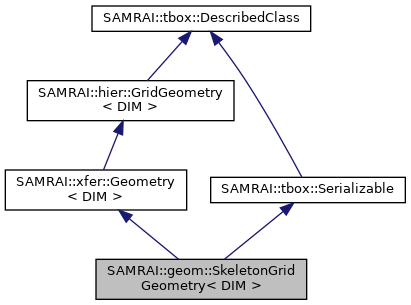
Class SkeletonGridGeometry is a concrete grid geometry class that contains no information about the physical domain characteristics of an AMR mesh apart from the index space. The purpose of this class is to allow an application that needs to use a special mesh to manage the physical domain within the application code. The skeleton grid geometry only manages the index space of the adaptive grid. This class sets geometry information on each patch in an AMR hierarchy. This class is derived from the xfer::Geometry<DIM> base class which is further derived from the hier::GridGeometry<DIM> base class.
An object of this class requires parameters to be read from input to create the hier::BoxArray that stores the index space in the hier::GridGeometry superclass. Also, data must be written to and read from files for restart. The input and restart data are summarized as follows:
Required input keys and data types:
- domain_boxes
Array of boxes representing the index space for the entire domain (on the coarsest refinement level).
Optional input keys, data types, and defaults:
- periodic_dimension
tbox::Array of integer values representing the directions in which the physical domain is periodic. A non-zero value indicates that the direction is periodic. A zero value indicates that
the direction is not periodic. If no values are specified, then the array is initialized to all zeros (no periodic directions). - use_original_location_indices Boolean argument used to tell whether to construct BoundaryBox objects with the original location index scheme that has existed in SAMRAI v. 1.4.0 and earlier or to use a new scheme that is compatible with the hier_BoundaryLookupTable. This only makes a difference for BoundaryBox objects in 3D with codimension 2.
If this keyword is omitted from input, the default value is true for dimension 3 and is irrelevant for any other dimension.
No input values can overwrite restart values.
A sample input file for a two-dimensional problem might look like:
*
*    domain_boxes = [(0,0) , (49,39)]
*    periodic_dimension = 0, 1  // periodic in y only
*    use_original_location_indices = TRUE
*
*
This generates a two-dimensional domain periodic in the y-direction, and having 50 cells in the x-direction and 40 cells in the y-direction.
- See also
- xfer::Geometry
- hier::GridGeometry
Constructor & Destructor Documentation
◆ SkeletonGridGeometry() [1/2]
| SAMRAI::geom::SkeletonGridGeometry< DIM >::SkeletonGridGeometry | ( | const std::string & | object_name, |
| tbox::Pointer< tbox::Database > | input_db, | ||
| bool | register_for_restart = true |
||
| ) |
Constructor for SkeletonGridGeometry initializes data members based on parameters read from the specified input and restart databases. The constructor also registers this object for restart using the specified object name, when the boolean argument is true. Whether object will write its state to restart files during program execution is determined by this argument.
Note that it has a default state of true.
Errors: passing in a null database pointer or an empty string will result in an unrecoverable assertion.
◆ SkeletonGridGeometry() [2/2]
| SAMRAI::geom::SkeletonGridGeometry< DIM >::SkeletonGridGeometry | ( | const std::string & | object_name, |
| const hier::BoxArray< DIM > & | level_domain, | ||
| bool | register_for_restart = true |
||
| ) |
Constructor for SkeletonGridGeometry sets index space domain based on arguments. The constructor also registers this object for restart using the specified object name, when the boolean argument is true. Whether object will write its state to restart files during program execution is determined by this argument.
Note that it has a default state of true.
Errors: passing in an empty string, or null data pointers will result in an unrecoverable assertion.
◆ ~SkeletonGridGeometry()
|
virtual |
Destructor for SkeletonGridGeometry unregisters the object with the restart manager if previously registered.
Member Function Documentation
◆ makeRefinedGridGeometry()
|
virtual |
Create and return a pointer to a refined version of this Cartesian grid geometry object. This function is pure virtual in the hier_GridGeometry base class.
Implements SAMRAI::hier::GridGeometry< DIM >.
◆ makeCoarsenedGridGeometry()
|
virtual |
Create and return a pointer to a coarsened version of this Cartesian grid geometry object. This function is pure virtual in the hier_GridGeometry base class.
Implements SAMRAI::hier::GridGeometry< DIM >.
◆ setGeometryDataOnPatch()
|
virtual |
Implements SAMRAI::hier::GridGeometry< DIM >.
◆ printClassData()
|
virtual |
Print class data representation.
Reimplemented from SAMRAI::xfer::Geometry< DIM >.
◆ putToDatabase()
|
virtual |
Writes the state of the SkeletonGridGeometry object to the database.
When assertion checking is active, db cannot be a null database pointer.
Implements SAMRAI::tbox::Serializable.
◆ getFromInput()
|
private |
◆ getFromRestart()
|
private |
◆ makeStandardOperators()
|
private |
◆ addSpatialCoarsenOperator()
|
virtualinherited |
Add concrete spatial coarsening operator instance to appropriate lookup list. Note that each concrete operator must implement a lookup function through which it can be identified.
◆ addSpatialRefineOperator()
|
virtualinherited |
Add concrete spatial refinement operator instance to appropriate lookup list. Note that each concrete operator must implement a lookup function through which it can be identified.
◆ addTimeInterpolateOperator()
|
virtualinherited |
Add concrete time interpolation operator instance to appropriate lookup list. Note that each concrete operator must implement a lookup function through which it can be identified.
◆ lookupCoarsenOperator()
|
virtualinherited |
Search list for the spatial coarsening operator matching the request for the given variable. If the operator is found, a pointer to it will be returned. Otherwise, an unrecoverable error will result and the program will abort.
◆ lookupRefineOperator()
|
virtualinherited |
Search list for the spatial refinement operator matching the request for the given variable. If the operator is found, a pointer to it will be returned. Otherwise, an unrecoverable error will result and the program will abort.
◆ lookupTimeInterpolateOperator()
|
virtualinherited |
Search list for the time interpolation operator matching the request for the given variable. If the operator is found, a pointer to it will be returned. Otherwise, an unrecoverable error will result and the program will abort.
◆ findPatchesTouchingBoundaries()
|
inherited |
This routine loops through all of the patches on the given level and determines which kinds of boundaries each patch touches. The 3-dimensional boolean arrays are set to store for each path whether it touches a regular boundary, a periodic boundary, both, or neither.
The array arguments should be uninitialized when they are passed into this function.
- Parameters
-
touches_regular_bdry Array to store which patches touch non-periodic boundaries. touches_periodic_bdry Array to store which patches touch periodic boundaries. level containing the patches to be checked periodic_shift periodic shift for the level (see getPeriodicShift) domain Physical domain (at the same level of refinement as level)
◆ setGeometryOnPatches()
|
virtualinherited |
This routine will pass the arrays containing the information about which patches touch which boundaries to the concrete grid geometry class. Also, if defer_boundary_box_creation is false, this routine will call a routine to construct all of the boundary boxes for the patches on level and will set them in the patch geometry for each patch.
- Parameters
-
level containing the patches to be checked. ratio_to_level_zero ratio to the coarsest level. touches_regular_bdry Array storing which patches touch non-periodic boundaries. touches_periodic_bdry Array storing which patches touch periodic boundaries. defer_boundary_box_creation Boundary boxes will be created here if false, not if true.
◆ setBoundaryBoxes()
|
inherited |
This routine constructs the boundary boxes for every patch in the level. Once constructed, the boundary boxes are set on each patch's PatchGeometry object.
- Parameters
-
level The level for which boundary boxes are constructed.
◆ computeShiftsForLevel()
|
inherited |
Compute the valid periodic shifts for each patch on a level. The shifts array will store a list of IntVectors for each patch. Each list will contain the valid possible periodic shifts for each particular patch. If there are no periodic boundary conditions or a patch does not touch a periodic boundary, the list for a patch will be empty.
The patch geometry object for each patch on the level must be properly initialized before calling this routine. This is typically done in the patch level constructor.
When assertion checking is active, the array of shifts in the argument list must have the same length as the number of patches on the level.
◆ computePhysicalDomain()
|
inherited |
Compute physical domain box array describing the index space of the physical domain managed by this geometry object. If any entry of ratio vector is negative, the index space is coarsened with respect to the physical domain description. Otherwise, the index space is refined.
◆ setPhysicalDomain()
|
inherited |
Set physical domain to input box array and determine whether domain is a single box.
◆ getPhysicalDomain()
|
inherited |
Return const reference to physical domain description for level 0.
◆ getDomainIsSingleBox()
|
inherited |
Return boolean value indicating whether the physical domain can be represented as a single box.
◆ initializePeriodicShift()
|
inherited |
Initialize the periodic shift on the coarsest level. The IntVector argument should be set to 1 for periodic directions and 0 for all other directions. The shift will be calculated to be the number of cells in the periodic direction and zero in all other directions.
◆ getPeriodicShift()
|
inherited |
Return IntVector<DIM> containing the periodic shift in each direction for a domain represented by a refinement of the reference physical domain (i.e. level zero) by the given ratio vector. tbox::Array entries will be zero for non-periodic directions. By default (i.e., when no argument is passed, the function returns the periodic shift for level zero in the hierarchy.
◆ computeMaxGhostWidth()
|
inherited |
Calculates the maximum ghost width for all the variables associated with the patch descriptor. This must only be called after all of the variables have been registered with the VariableDatabase. If a variable is added that changes the maximum ghost width, then an assertion failure will result.
◆ computeBoundaryBoxesOnLevel()
|
inherited |
The DIM arrays of boundary boxes for each patch will be stored in groups of DIM. For example, in 3d with n patches on the level, the array For example, in 3d with n patches on the level, the array of boundary box arrays will be ordered as follows:
* (patch 0 face array, patch 0 edge array, patch 0 node array,
*  patch 1 face array, patch 1 edge array, patch 1 node array, . . . ,
*  patch n-1 face array, patch n-1 edge array, patch n-1 node array)
*
The optional argument do_all_patches defaults to false, in which case the boundary box computation is executed only on patches that touch a non-periodic boundary. When this routine is called during patch level construction to describe a physical boundary, it is known that only patches that touch a non-periodic boundary will have non-empty sets of boundary boxes, so for efficiency's sake the boundary box box computation is supressed for all other patches. When this routine is called to create boundary boxes that describe a coarse-fine boundary, the computation must occur for every patch, so do_all_patches mush be set to true.
- Parameters
-
boundaries output boundary description level level on which to generate boundaries periodic_shift periodic shift for the level (see getPeriodicShift) ghost_width ghost width to compute geometry for domain Physical domain (in index space of level) for computing boundary boxes. do_all_patches Execute boundary box computation on all patches, even those known to not touch a boundary
◆ getBoundaryBoxes()
|
inherited |
Decompose patch boundary region into pieces depending on spatial dim. Boxes are extended along the boundary to the edge of the ghost layer if necessary.
◆ checkPeriodicValidity()
|
privateinherited |
◆ checkBoundaryBox()
|
privateinherited |
This is a check performed on each BoundaryBox when it is created. It returns true when a BoundaryBox has a width of 1 in at least one direction, is adjacent to the patch boundary (possible extended into the patch's ghost region) and is outside the physical domain.
◆ computeShiftsForPatch()
|
privateinherited |
If box is located on a periodic boundary, all of its possible shifts will be computed and stored in shifts. If box is not on a periodic boundary, shifts will be an empty list.
Member Data Documentation
◆ d_object_name
|
private |
◆ d_registered_for_restart
|
private |
◆ d_using_original_locations
|
private |
◆ d_coarsen_operators
|
privateinherited |
◆ d_refine_operators
|
privateinherited |
◆ d_time_operators
|
privateinherited |
◆ d_physical_domain
|
privateinherited |
Box array defining computational domain on coarsest level and boolean flag that is true when domain is a single box.
◆ d_domain_is_single_box
|
privateinherited |
◆ d_periodic_shift
|
privateinherited |
Integer array vector describing periodic shift coarsest level. An entry of zero means direction is not periodic.
◆ d_max_data_ghost_width
|
privateinherited |
Current maximum ghost cell width over all patch data objects known to the patch descriptor. This is used to compute boundary boxes.
The documentation for this class was generated from the following file:
- /samrai/include/SkeletonGridGeometry.h