#include <SkeletonPatchGeometry.h>
template<int DIM>
class SAMRAI::geom::SkeletonPatchGeometry< DIM >
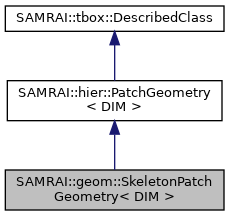
Class SkeletonPatchGeometry implements geometry management for a single patch in an AMR hierarchy with no information about the physical characteristics of the problem. This is intended for use in an application that will manage the physical geometry in user-defined code.
The grid data is set by SkeletonGridGeometry class. This patch geometry class is derived from hier::PatchGeometry<DIM> base class.
- See also
- hier::BoundaryBox
-
hier::PatchGeometry
-
geom::SkeletonGridGeometry
◆ SkeletonPatchGeometry() [1/2]
◆ ~SkeletonPatchGeometry()
◆ SkeletonPatchGeometry() [2/2]
◆ printClassData()
◆ operator=()
◆ getPatchBoundaries()
Return const reference to patch boundary information.
◆ setBoundaryBoxesOnPatch()
An array of length DIM of tbox::Array< BoundaryBox<DIM> > is passed in to be stored as the boundary boxes for this patch geometry.
- Parameters
-
| bdry | The array of BoundaryBox arrays. |
◆ getRatio()
Return const reference to ratio to level zero index space.
◆ intersectsPhysicalBoundary()
Return a boolean value indicating whether the patch boundary intersects the physical domain boundary in a non-periodic direction. In other words, the return value is true when the patch has non-empty boundary boxes that lie outside the physical domain. Otherwise, the return value is false. Note that when a patch touches the "boundary" of the physical domain in a periodic direction, there are no boundary boxes to fill; the data is filled from the proper region of the domain interior in the periodic direction.
◆ getNodeBoundaries()
Return array of boundary box components for patch each of which intersects the patch at a single point (i.e., 0-dim intersection between cells in patch and cells in boundary box).
◆ getEdgeBoundaries()
Return array of boundary box components for patch each of which intersects the patch along a 1-dim edge (i.e., 1-dim intersection between cells in patch and cells in boundary box).
When assertion checking is active, this routine throws an assertion when DIM < 2.
◆ getFaceBoundaries()
Return array of boundary box components for patch each of which intersects the patch along a 2-dim face (i.e., 2-dim intersection between cells in patch and cells in boundary box).
When assertion checking is active, this routine throws an assertion when DIM < 3.
◆ getCodimensionBoundaries()
Return array of boundary box components for patch each of which intersects the patch as a (DIM - codim)-dimensional object. That is,
if DIM == 1: (codim == 1) => same components as getNodeBoundaries.
if DIM == 2, (codim == 1) => same components as getEdgeBoundaries.
(codim == 2) => same components as getNodeBoundaries.
if DIM == 3, (codim == 1) => same components as getFaceBoundaries.
(codim == 2) => same components as getEdgeBoundaries.
(codim == 3) => same components as getNodeBoundaries.
When assertion checking is active, this routine throws an assertion when codim < 0 or codim > DIM.
◆ setCodimensionBoundaries()
Set the array of boundary box components of the given codimension for a patch.
◆ getBoundaryFillBox()
The patch box will be grown by the given ghost cell width and then intersected with the boundary box. The resulting intersection will be grown to the needed ghost cell width in the direction normal to the boundary.
- Parameters
-
| bbox | BoundaryBox representing location and type of boundary |
| patch_box | The box for the patch where data is being filled |
| gcw | ghost cell width to fill |
◆ getTouchesRegularBoundary() [1/2]
Returns true if the Patch touches any non-periodic physical boundary
◆ getTouchesRegularBoundary() [2/2]
Returns true if the Patch touches a non-periodic physical boundary on the side of the Patch specified in the argument list. The side is specified by an axis direction and a flag specified the upper or lower side.
- Parameters
-
| axis | Axis direction normal to the side being checked |
| upperlower | Flag should be 0 if checking the lower side in the axis direction, or 1 if checking the upper side. |
◆ getTouchesPeriodicBoundary() [1/2]
Returns true if the Patch touches any periodic boundary
◆ getTouchesPeriodicBoundary() [2/2]
Returns true if the Patch touches a periodic boundary on the side of the Patch specified in the argument list. The side is specified by an axis direction and a flag specified the upper or lower side.
- Parameters
-
| axis | Axis direction normal to the side being checked |
| upperlower | Flag should be 0 if checking the lower side in the axis direction, or 1 if checking the upper side. |
◆ d_has_regular_boundary
◆ d_has_periodic_boundary
◆ d_ratio_to_level_zero
◆ d_patch_boundaries
◆ d_touches_regular_bdry
◆ d_touches_periodic_bdry
The documentation for this class was generated from the following file: