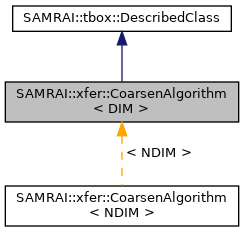
Class CoarsenAlgorithm<DIM> encapsulates the AMR communication pattern to coarsen data from a finer level to any coarser level.
Most often, data is coarsened from the interiors of source patch components on the source patch level into interiors of destination patch components on the destination level. See comments for the coarsen algorithm constructor for variations that are possible for (adventurous?) users. If the coarsening operators require ghost cells on a source component, then sufficient ghost cell storage must be provided by the source patch data component, and those ghost cells must be filled before calling the data coarsening routines.
More...
|
| | CoarsenAlgorithm (bool fill_coarse_data=false) |
| |
| virtual | ~CoarsenAlgorithm () |
| |
| void | registerCoarsen (const int dst, const int src, const tbox::Pointer< xfer::CoarsenOperator< DIM > > opcoarsen, const hier::IntVector< DIM > &gcw_to_coarsen=hier::IntVector< DIM >(0)) |
| |
| tbox::Pointer< xfer::CoarsenSchedule< DIM > > | createSchedule (tbox::Pointer< hier::PatchLevel< DIM > > crse_level, tbox::Pointer< hier::PatchLevel< DIM > > fine_level, xfer::CoarsenPatchStrategy< DIM > *patch_strategy=((xfer::CoarsenPatchStrategy< DIM > *) NULL), tbox::Pointer< xfer::CoarsenTransactionFactory< DIM > > transaction_factory=(xfer::CoarsenTransactionFactory< DIM > *) NULL) |
| |
| bool | checkConsistency (tbox::Pointer< xfer::CoarsenSchedule< DIM > > schedule) const |
| | Given a previously-generated coarsen schedule, check for consistency with this coarsen algorithm object to see whether a call to resetSchedule is a valid operation. More...
|
| |
| void | resetSchedule (tbox::Pointer< xfer::CoarsenSchedule< DIM > > schedule) const |
| | Given a previously-generated coarsen schedule, reconfigure it to peform the communication operations registered with this coarsen algorithm object. That is, the schedule will be transformed so that it will function as though this coarsen algorithm created it. Note that the set of operations registered with this coarsen algorithm must be essentially the same as those registered with the coarsen algorithm that created the schedule originally. That is, the number of operations registered must be the same and the source and destination patch data items and operators must have identical characteristics (i.e., data centering, ghost cell widths, stencil requirements, etc.). However, the specific source, destination patch data ids and operators can be different. Detailed and fairly complete error checking is performed when this routine is called to prevent potential errors or unexpected behavior. More...
|
| |
| virtual void | printClassData (std::ostream &stream) const |
| |
template<int DIM>
class SAMRAI::xfer::CoarsenAlgorithm< DIM >
Communication algorithms generally consist of three parts: an algorithm, a schedule, and a patch strategy. The algorithm describes the communication between patch data items but is independent of the configuration of the AMR hierarchy. hier::Patch data items and their associated coarsening operators are registered with the algorithm. To generate the communication dependencies for a particular hierarchy configuration, the algorithm generates a schedule based on the current hierarchy configuration. This schedule then performs the communication based on the registered data types and their associated operators. User-defined pre-processing and post-processing are provided through the abstract patch strategy class.
The source patch data space is used during processing to store temporary data. Thus, the user-defined coarsening operators should operate on the source space by using the patch data with those indices.
Note that each coarsen schedule created by a coarsen algorithm remains valid as long as the patches involved in the communication process do not change; thus, they can be used for multiple data communication cycles.
Typical usage of a coarsen algorithm to perform data coarsening on an AMR hierarchy involves four steps:
- Construct a coarsen algorithm object.
- Register coarsen operations with the coarsen algorithm. Using the registerCoarsen() methods(s), one provides source and destination patch data information, as well as spatial coarsening operators as needed.
- After all operations are registered with the algorithm, one creates a communication schedule using the createSchedule() method. This method identifies the source (fine) and destination (coarse) patch levels for data coarsening. Note that when creating a communication schedule, a concrete instance of a CoarsenPatchStrategy<DIM> object may be required to supply user-defined spatial data coarsening operations.
- Invoke the coarsenData() method in the communication schedule to perform the data transfers.
User-defined coarsening operations can be written using the interfaces in CoarsenPatchStrategy for preprocessCoarsen() and postProcessCoarsen(). Users who use create these operations must note that all data that is to be used in such operations should be registered with the CoarsenAlgorithm using registerCoarsen(), whether or not the data is to be coarsened.
- See also
- xfer::CoarsenSchedule
-
xfer::CoarsenPatchStrategy
-
xfer::CoarsenClasses
Register a coarsening operation with the coarsening algorithm. Data from the interiors of the source component on a source (fine) patch level will be coarsened into the source component of a temporary (coarse) patch level and then copied into the destination component on the destination (coarse) patch level. If the coarsening operator requires data in ghost cells outside of the patch interiors (i.e., a non-zero stencil width), then those ghost cells must exist in the source patch data component and the ghost cells must be filled with valid data on the source level before a call to invoke the communication schedule. Note that the source and destination components may be the same in any case.
Some special circumstances require that data be coarsened from the ghost cell regions of a finer level and the resulting coarsened data should be copied to the destination patch level. When this is the case, the optional integer vector argument should be set to the cell width, in the destination (coarser) level index space, of the region around the fine level where this coarsening should occur. For example, if the coarser level needs data in a region two (coarse) cells wide around the boundary of the finer level, then the gcw_to_coarsen should be set to a vector with all entries set to two. Moreover, if the refinement ratio between coarse and fine levels is four in this case, then the source patch data is required to have at least eight ghost cells.
- Parameters
-
| dst | hier::Patch data index filled on destination level. |
| src | hier::Patch data index coarsened from the source level. |
| opcoarsen | tbox::Pointer to coarsening operator. This may be a null pointer. In this case, coarsening must be handled by the coarsen patch strategy member functions. See the comments for CoarsenPatchStrategy<DIM>::preprocessCoarsen() and CoarsenPatchStrategy<DIM>::postprocessCoarsen(). |
| gcw_to_coarsen | Integer vector ghost cell width when data should be coarsened from ghost cell regions of the source (finer) level into the destination (coarser) level. By default, it is the vector of zeros indicating that data should be coarsened from from patch interiors on the source level. If this argument is used, its value should be the cell width, in the destination (coarser) level index space, of the region around the fine level where this coarsening should occur. This argument should only be provided by those who specifically require this special behavior and know how to properly process the patch data on coarse and fine patch levels during the coarsening process. |