FAC operator class to solve Poisson's equation on a SAMR grid, using cell-centered, second-order finite-volume method, with Robin boundary conditions. More...
#include <CellPoissonFACOps.h>
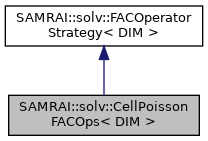
Public Member Functions | |
| CellPoissonFACOps (const std::string &object_name=std::string(), tbox::Pointer< tbox::Database > database=NULL) | |
| Constructor. More... | |
| ~CellPoissonFACOps () | |
| Destructor. More... | |
| void | setPoissonSpecifications (const PoissonSpecifications &spec) |
| Set the scalar Poisson equation specifications. More... | |
| void | enableLogging (bool enable_logging) |
| Enable logging. More... | |
Functions for setting solver mathematic algorithm controls | |
| void | setSmoothingChoice (const std::string &smoothing_choice) |
| Set the choice of smoothing algorithms. More... | |
| void | setCoarsestLevelSolverChoice (const std::string &choice) |
| Set coarse level solver. More... | |
| void | setCoarsestLevelSolverTolerance (double tol) |
| Set tolerance for coarse level solve. More... | |
| void | setCoarsestLevelSolverMaxIterations (int max_iterations) |
| Set max iterations for coarse level solve. More... | |
| void | setCoarseFineDiscretization (const std::string &coarsefine_method) |
| Set the coarse-fine boundary discretization method. More... | |
| void | setProlongationMethod (const std::string &prolongation_method) |
| Set the name of the prolongation method. More... | |
Functions for setting patch data indices and coefficients | |
| void | setFluxId (int flux_id) |
| Set the scratch patch data index for the flux. More... | |
| void | setPhysicalBcCoefObject (const RobinBcCoefStrategy< DIM > *physical_bc_coef) |
| Provide an implementation for getting the physical bc coefficients. More... | |
Functions for checking validity and correctness of state. | |
| void | checkInputPatchDataIndices () const |
| Check validity and correctness of input patch data indices. More... | |
| void | computeVectorWeights (tbox::Pointer< hier::PatchHierarchy< DIM > > hierarchy, int weight_id, int coarsest_ln=-1, int finest_ln=-1) const |
| Set weight appropriate for computing vector norms. More... | |
| void | setPreconditioner (const FACPreconditioner< DIM > *preconditioner) |
| Set the FAC preconditioner that will be using this object. More... | |
| void | computeFluxOnPatch (const hier::Patch< DIM > &patch, const hier::IntVector< DIM > &ratio_to_coarser_level, const pdat::CellData< DIM, double > &w_data, pdat::SideData< DIM, double > &Dgradw_data) const |
| function to compute flux, using general diffusion coefficient data. More... | |
| virtual void | restrictSolution (const SAMRAIVectorReal< DIM, double > &source, SAMRAIVectorReal< DIM, double > &dest, int dest_ln) |
| Restrict the solution quantity to the specified level from the next finer level. More... | |
| virtual void | restrictResidual (const SAMRAIVectorReal< DIM, double > &source, SAMRAIVectorReal< DIM, double > &dest, int dest_ln) |
| Restrict the residual quantity to the specified level from the next finer level. More... | |
| virtual void | prolongErrorAndCorrect (const SAMRAIVectorReal< DIM, double > &source, SAMRAIVectorReal< DIM, double > &dest, int dest_ln) |
| Prolong the error quantity to the specified level from the next coarser level and apply the correction to the fine-level error. More... | |
| virtual void | smoothError (SAMRAIVectorReal< DIM, double > &error, const SAMRAIVectorReal< DIM, double > &residual, int ln, int num_sweeps) |
| Perform a given number of relaxations on the error. More... | |
| virtual int | solveCoarsestLevel (SAMRAIVectorReal< DIM, double > &error, const SAMRAIVectorReal< DIM, double > &residual, int coarsest_ln) |
| Solve the residual equation Ae=r on the coarsest level in the FAC iteration. More... | |
| virtual void | computeCompositeResidualOnLevel (SAMRAIVectorReal< DIM, double > &residual, const SAMRAIVectorReal< DIM, double > &solution, const SAMRAIVectorReal< DIM, double > &rhs, int ln, bool error_equation_indicator) |
| Compute composite grid residual on a single level. More... | |
| virtual double | computeResidualNorm (const SAMRAIVectorReal< DIM, double > &residual, int fine_ln, int coarse_ln) |
| Compute the norm of the residual quantity. More... | |
| virtual void | initializeOperatorState (const SAMRAIVectorReal< DIM, double > &solution, const SAMRAIVectorReal< DIM, double > &rhs) |
| Compute hierarchy-dependent data if any is required. More... | |
| virtual void | deallocateOperatorState () |
| Remove all hierarchy-dependent data. More... | |
| virtual void | postprocessOneCycle (int fac_cycle_num, const SAMRAIVectorReal< DIM, double > ¤t_soln, const SAMRAIVectorReal< DIM, double > &residual) |
| Regular call back routine to be called after each FAC cycle. More... | |
Private workhorse functions. | |
| std::string | d_object_name |
| Object name. More... | |
| tbox::Pointer< hier::PatchHierarchy< DIM > > | d_hierarchy |
| Reference hierarchy. More... | |
| int | d_ln_min |
| Coarsest level for solve. More... | |
| int | d_ln_max |
| Finest level for solve. More... | |
| tbox::Array< hier::CoarseFineBoundary< DIM > > | d_cf_boundary |
| Description of coarse-fine boundaries. More... | |
| void | smoothErrorByRedBlack (SAMRAIVectorReal< DIM, double > &error, const SAMRAIVectorReal< DIM, double > &residual, int ln, int num_sweeps, double residual_tolerance=-1.0) |
| Red-black Gauss-Seidel error smoothing on a level. More... | |
| int | solveCoarsestLevel_HYPRE (SAMRAIVectorReal< DIM, double > &error, const SAMRAIVectorReal< DIM, double > &residual, int ln) |
| Solve the coarsest level using HYPRE. More... | |
| void | ewingFixFlux (const hier::Patch< DIM > &patch, const pdat::CellData< DIM, double > &soln_data, pdat::SideData< DIM, double > &flux_data, const hier::IntVector< DIM > &ratio_to_coarser) const |
| Fix flux per Ewing's coarse-fine boundary treatment. More... | |
| void | computeResidualOnPatch (const hier::Patch< DIM > &patch, const pdat::SideData< DIM, double > &flux_data, const pdat::CellData< DIM, double > &soln_data, const pdat::CellData< DIM, double > &rhs_data, pdat::CellData< DIM, double > &residual_data) const |
| AMR-unaware function to compute residual on a single patch, with variable scalar field. More... | |
| void | redOrBlackSmoothingOnPatch (const hier::Patch< DIM > &patch, const pdat::SideData< DIM, double > &flux_data, const pdat::CellData< DIM, double > &rhs_data, pdat::CellData< DIM, double > &soln_data, char red_or_black, double *p_maxres=NULL) const |
| AMR-unaware function to red or black smoothing on a single patch, for variable diffusion coefficient and variable scalar field. More... | |
| void | xeqScheduleProlongation (int dst_id, int src_id, int scr_id, int dest_ln) |
| Execute a refinement schedule for prolonging cell data. More... | |
| void | xeqScheduleURestriction (int dst_id, int src_id, int dest_ln) |
| Execute schedule for restricting solution to the specified level or reregister an existing one. More... | |
| void | xeqScheduleRRestriction (int dst_id, int src_id, int dest_ln) |
| Execute schedule for restricting residual to the specified level or reregister an existing one. More... | |
| void | xeqScheduleFluxCoarsen (int dst_id, int src_id, int dest_ln) |
| Execute schedule for coarsening flux to the specified level or reregister an existing one. More... | |
| void | xeqScheduleGhostFill (int dst_id, int dest_ln) |
| Execute schedule for filling ghosts on the specified level or reregister an existing one. More... | |
| void | xeqScheduleGhostFillNoCoarse (int dst_id, int dest_ln) |
| Execute schedule for filling ghosts on the specified level or reregister an existing one. This version does not get data from coarser levels. More... | |
| int | registerCellScratch () const |
| Return the patch data index for cell scratch data. More... | |
| int | registerFluxScratch () const |
| Return the patch data index for flux scratch data. More... | |
| int | registerOfluxScratch () const |
| Return the patch data index for outerflux scratch data. More... | |
| static void | freeVariables () |
| Free static variables at shutdown time. More... | |
Private state variables for solution process. | |
| PoissonSpecifications | d_poisson_spec |
| Scalar Poisson equations specifications. More... | |
| std::string | d_smoothing_choice |
| Smoothing choice. More... | |
| std::string | d_coarse_solver_choice |
| Coarse level solver. More... | |
| std::string | d_cf_discretization |
| Coarse-fine discretization method. More... | |
| std::string | d_prolongation_method |
| Coarse-fine discretization method. More... | |
| double | d_coarse_solver_tolerance |
| Tolerance specified to coarse solver. More... | |
| int | d_coarse_solver_max_iterations |
| Coarse level solver iteration limit. More... | |
| double | d_residual_tolerance_during_smoothing |
| Residual tolerance to govern smoothing. More... | |
| int | d_flux_id |
| Id of the flux. More... | |
| const RobinBcCoefStrategy< DIM > * | d_physical_bc_coef |
| Externally provided physical boundary condition object. More... | |
| tbox::Pointer< hier::VariableContext > | d_context |
| Default context of internally maintained hierarchy data. More... | |
| int | d_cell_scratch_id |
| ID of the solution-like scratch data. More... | |
| int | d_flux_scratch_id |
| ID of the side-centered scratch data. More... | |
| int | d_oflux_scratch_id |
| ID of the outerside-centered scratch data. More... | |
| static tbox::Pointer< pdat::CellVariable< DIM, double > > | s_cell_scratch_var |
| static tbox::Pointer< pdat::SideVariable< DIM, double > > | s_flux_scratch_var |
| static tbox::Pointer< pdat::OutersideVariable< DIM, double > > | s_oflux_scratch_var |
Detailed Description
template<int DIM>
class SAMRAI::solv::CellPoissonFACOps< DIM >
This class provides operators that are used by the FAC preconditioner FACPreconditioner<DIM>. It is used to solve the scalar Poisson's equation using a cell-centered second-order finite-volume discretization. It is designed to provide all operations specific to the scalar Poisson's equation,
\[ \nabla \cdot D \nabla u + C u = f \]
(see PoissonSpecifications) where
- C, D and f are indpendent of u
- C is a cell-centered scalar field
- D is the diffusion coefficients, stored on faces
- f is a cell-centered scalar function
You are left to provide the source function, initial guess, etc., by specifying them in specific forms.
This class provides:
- 5-point (second order), cell-centered stencil operations for the discrete Laplacian.
- Red-black Gauss-Seidel smoothing.
- Provisions for working Robin boundary conditions (see RobinBcCoefStrategy).
This class is meant to provide the Poisson-specific operator used by the FAC preconditioner, FACPreconditioner<DIM>. To use the preconditioner with this class, you will have to provide:
- The solution vector SAMRAIVectorReal<DIM>, with appropriate norm weighting for the cell-centered AMR mesh. This class provides the function computeVectorWeights() to help with computing the appropriate weights. Since this is for a scalar equation, only the first depth of the first component of the vectors are used. All other parts are ignored.
- The source vector SAMRAIVectorReal<DIM> for f.
- A PoissonSpecifications objects to specify the cell-centered scalar field C and the side-centered diffusion coefficients D
- The boundary condition specifications in terms of the coefficients \( \alpha \), \( \beta \) and \( \gamma \) in the Robin formula \( \alpha u + \beta u_n = \gamma \) applied on the boundary faces. See RobinBcCoefStrategy<DIM>.
This class allocates and deallocates only its own scratch data. Other data that it manipuates are passed in as function arguments. Hence, it owns none of the solution vectors, error vectors, diffusion coefficient data, or any such things.
Input Examples
* coarse_solver_choice = "hypre"    // see setCoarsestLevelSolverChoice()
* coarse_solver_tolerance = 1e-14   // see setCoarsestLevelSolverTolerance()
* coarse_solver_max_iterations = 10 // see setCoarsestLevelSolverMaxIterations()
* smoothing_choice = "redblack"     // see setSmoothingChoice()
* cf_discretization = "Ewing"       // see setCoarseFineDiscretization()
* prolongation_method = "LINEAR_REFINE" // see setProlongationMethod()
* hypre_solver = { ... }            // tbox::Database for initializing Hypre solver
*
Constructor & Destructor Documentation
◆ CellPoissonFACOps()
| SAMRAI::solv::CellPoissonFACOps< DIM >::CellPoissonFACOps | ( | const std::string & | object_name = std::string(), |
| tbox::Pointer< tbox::Database > | database = NULL |
||
| ) |
If you want standard output and logging, pass in valid pointers for those streams.
- Parameters
-
object_name Ojbect name database Input database
◆ ~CellPoissonFACOps()
| SAMRAI::solv::CellPoissonFACOps< DIM >::~CellPoissonFACOps | ( | ) |
Deallocate internal data.
Member Function Documentation
◆ setPoissonSpecifications()
| void SAMRAI::solv::CellPoissonFACOps< DIM >::setPoissonSpecifications | ( | const PoissonSpecifications & | spec | ) |
◆ enableLogging()
| void SAMRAI::solv::CellPoissonFACOps< DIM >::enableLogging | ( | bool | enable_logging | ) |
By default, logging is disabled. The logging flag is propagated to the major components used by this class.
◆ setSmoothingChoice()
| void SAMRAI::solv::CellPoissonFACOps< DIM >::setSmoothingChoice | ( | const std::string & | smoothing_choice | ) |
Current smoothing choices are:
- "redblack": Red-black Gauss-Seidel smoothing.
◆ setCoarsestLevelSolverChoice()
| void SAMRAI::solv::CellPoissonFACOps< DIM >::setCoarsestLevelSolverChoice | ( | const std::string & | choice | ) |
Select from these:
"redblack"(red-black smoothing until convergence–very slow!)"hypre"(only if the HYPRE library is available).
◆ setCoarsestLevelSolverTolerance()
| void SAMRAI::solv::CellPoissonFACOps< DIM >::setCoarsestLevelSolverTolerance | ( | double | tol | ) |
If the coarse level solver requires a tolerance (currently, they all do), the specified value is used.
◆ setCoarsestLevelSolverMaxIterations()
| void SAMRAI::solv::CellPoissonFACOps< DIM >::setCoarsestLevelSolverMaxIterations | ( | int | max_iterations | ) |
If the coarse level solver requires a max iteration limit (currently, they all do), the specified value is used.
◆ setCoarseFineDiscretization()
| void SAMRAI::solv::CellPoissonFACOps< DIM >::setCoarseFineDiscretization | ( | const std::string & | coarsefine_method | ) |
Specify the op_name string which will be passed to xfer::Geometry<DIM>::lookupRefineOperator() to get the operator for setting fine grid ghost cells from the coarse grid. Note that chosing this operator implicitly choses the discretization method at the coarse-fine boundary.
There is one important instance where this string is not passed to xfer::Geometry<DIM>::lookupRefineOperator. If this variable is set to "Ewing", Ewing's coarse-fine discretization is used (a constant refinement is performed, and the flux is later corrected to result in Ewing's scheme). For a reference to Ewing's discretization method, see "Local Refinement Techniques for Elliptic Problems on Cell-Centered Grids, I. Error Analysis", Mathematics of Computation, Vol. 56, No. 194, April 1991, pp. 437-461.
- Parameters
-
coarsefine_method String selecting the coarse-fine discretization method.
◆ setProlongationMethod()
| void SAMRAI::solv::CellPoissonFACOps< DIM >::setProlongationMethod | ( | const std::string & | prolongation_method | ) |
Specify the op_name string which will be passed to xfer::Geometry<DIM>::lookupRefineOperator() to get the operator for prolonging the coarse-grid correction.
By default, "CONSTANT_REFINE" is used. "LINEAR_REFINE" seems to to lead to faster convergence, but it does NOT satisfy the Galerkin condition.
Prolonging using linear refinement requires a Robin bc coefficient implementation that is capable of delivering coefficients for non-hierarchy data, because linear refinement requires boundary conditions to be set on temporary levels.
- Parameters
-
prolongation_method String selecting the coarse-fine discretization method.
◆ setFluxId()
| void SAMRAI::solv::CellPoissonFACOps< DIM >::setFluxId | ( | int | flux_id | ) |
The use of this function is optional. The patch data index should be a pdat::SideData<DIM> type of variable. If the flux id is -1 (the default initial value), scratch space for the flux is allocated as needed and immediately deallocated afterward, level by level. If you have space preallocated for flux and you would like that to be used, set flux id to the patch data index of that space.
◆ setPhysicalBcCoefObject()
| void SAMRAI::solv::CellPoissonFACOps< DIM >::setPhysicalBcCoefObject | ( | const RobinBcCoefStrategy< DIM > * | physical_bc_coef | ) |
If your solution is fixed at the physical boundary ghost cell centers AND those cells have the correct values before entering solveSystem(), you may use a GhostCellRobinBcCoefs<DIM> object.
If your solution is not fixed at the ghost cell centers, the ghost cell values will change as the interior cell values change. In those cases, the flexible Robin boundary conditions are applied. You must call this function to provide the implementation for determining the boundary condition coefficients.
- Parameters
-
physical_bc_coef tbox::Pointer to an object that can set the Robin bc coefficients.
◆ checkInputPatchDataIndices()
| void SAMRAI::solv::CellPoissonFACOps< DIM >::checkInputPatchDataIndices | ( | ) | const |
Descriptors checked:
- Diffusion coefficient (see setDiffcoefId())
- Flux (see setFluxId())
- Source (see setScalarFieldId())
◆ computeVectorWeights()
| void SAMRAI::solv::CellPoissonFACOps< DIM >::computeVectorWeights | ( | tbox::Pointer< hier::PatchHierarchy< DIM > > | hierarchy, |
| int | weight_id, | ||
| int | coarsest_ln = -1, |
||
| int | finest_ln = -1 |
||
| ) | const |
If you this function to set the weights used when you SAMRAIVectorReal<DIM>::addComponent, you can use the vector norm functions of SAMRAIVectorReal<DIM>, and the weights will be used to blank out coarse grid regions under fine grids.
The weights computed are specific to the cell-centered discretization used by this class. The weight is equal to the cell volume if the cell has not been refined, and zero if it has.
This function is state-independent. All inputs are in the argument list.
- Parameters
-
hierarchy Hierarchy configuration to compute weights for weight_id hier::Patch data index of the weight coarsest_ln Coarsest level number. Must be included in hierarchy. Must not be greater than finest_ln. Default to 0.finest_ln Finest level number. Must be included in hierarchy. Must not be less than coarsest_ln. Default to finest level inhierarchy.
◆ setPreconditioner()
| void SAMRAI::solv::CellPoissonFACOps< DIM >::setPreconditioner | ( | const FACPreconditioner< DIM > * | preconditioner | ) |
The FAC preconditioner is accessed to get convergence data during the cycle postprocessing step. It is optional.
◆ computeFluxOnPatch()
| void SAMRAI::solv::CellPoissonFACOps< DIM >::computeFluxOnPatch | ( | const hier::Patch< DIM > & | patch, |
| const hier::IntVector< DIM > & | ratio_to_coarser_level, | ||
| const pdat::CellData< DIM, double > & | w_data, | ||
| pdat::SideData< DIM, double > & | Dgradw_data | ||
| ) | const |
Recall that this solver class discretizes the PDE
\[ \nabla \cdot D \nabla u + C u = f \]
on an AMR grid. This member function allows users of this solver class to compute gradient terms,
\[ D \nabla w \]
, in their code in a manner consistent with the solver discretization. In particular, when solving PDE systems, it may be necessary to discretize the gradient operator appearing in equations not treated by the solver class in the same way as those treated by this class. These funtions allow users to do this easily. The divergence operator used in this solver is the standard sum of centered differences involving flux terms on the cell sides computed by these routines.
Note that the patch must exist on a level in an AMR hierarchy so that the discretization can be computed properly at the coarse-fine interface. Poisson coefficients C and D must exist on the patch, if they are variable. Also, calling this function does not affect the internal solver state in any way. However, the solver must be fully initialized before it is called and care should be exercised to pass arguments so that the solver solution quantity and other internal solver quantities are not adversely affected.
- Parameters
-
patch patch on which computation will take place ratio_to_coarser_level refinement ratio from coarser level to level on which patch lives; if current patch level is level zero, this is ignored w_data cell-centered data Dgradw_data side-centered flux data (i.e., D (grad w))
◆ restrictSolution()
|
virtual |
Restrict the residual data to level dest_ln in the destination vector d, from level dest_ln+1 in the source vector s.
Can assume:
- dest_ln is not the finest level in the range being solved.
- corresponding solution has been computed on level dest_ln+1.
- the source and destination residual vectors (s and d) may or may not be the same. (This function must work in either case.)
Upon return from this function, the solution on the refined region of the coarse level will represent the coarsened version of the fine solution in a manner that is consistent with the linear system approximation on the composite grid. This function must not change the solution values anywhere except on level dest_ln of the destination vector.
The source and destination vectors may be the same.
- Parameters
-
source source solution dest destination solution dest_ln destination level number
Implements SAMRAI::solv::FACOperatorStrategy< DIM >.
◆ restrictResidual()
|
virtual |
Restrict the residual data to level dest_ln in the destination vector d, from level dest_ln+1 in the source vector s.
Can assume:
- dest_ln is not the finest level in the range being solved.
- correspnding residual has been computed on level dest_ln+1.
- the source and destination residual vectors (s and d) may or may not be the same. (This function must work in either case.)
Upon return from this function, the residual on the refined region of the coarse level will represent the coarsened version of the fine residual in a manner that is consistent with the linear system approximation on the composite grid. This function must not change the residual values anywhere except on level dest_ln of the destination vector.
The source and destination vectors may be the same.
- Parameters
-
source source residual dest destination residual dest_ln destination level number
Implements SAMRAI::solv::FACOperatorStrategy< DIM >.
◆ prolongErrorAndCorrect()
|
virtual |
On the part of the coarse level that does not overlap the fine level, the error is the corection to Au=f.
On the part of the coarse level that does overlap the fine level, the error is the corection to Ae=r of the fine level.
This function should apply the coarse-level correction to the fine level, that is
\[ e^{fine} \leftarrow e^{fine} + I^{fine}_{coarse} e^{coarse} \]
Note: You probably have to store the refined error in a temporary location before adding it to the current error.
The array of boundary information contains a description of the coarse-fine level boundary for each patch on the level; the boundary information for patch N is obtained as the N-th element in the array, coarse_fine_boundary[N].
Upon return from this function, the error on the fine level must represent the correction to the solution on that level. Also, this function must not change the error values on the coarse level.
The source and destination vectors may be the same.
- Parameters
-
source source error vector dest destination error vector dest_ln destination level number of data transfer
Implements SAMRAI::solv::FACOperatorStrategy< DIM >.
◆ smoothError()
|
virtual |
Relax the residual equation Ae=r by applying the given number of smoothing sweeps on the specified level. The relaxation may ignore the possible existence of finer levels on a given level.
The array of boundary information contains a description of the coarse-fine level boundary for each patch on the level; the boundary information for patch N is obtained as the N-th element in the array, coarse_fine_boundary[N].
May assume:
- If intermediate data from level l+1 is needed (for example, to match flux at coarse-fine boundaries), that data is already computed and stored on level l+1.
- The error in the next finer level has been computed and stored there.
Steps for each iteration.
- Fill ghost boundaries
- Compute intermediate data (if needed) and coarsen intermediate data stored in level l+1 (if needed).
- Perform relaxation step (update e toward a better approximation).
Final step before leaving function.
- If needed, compute and store intermediate data for next coarser level l-1.
- Parameters
-
error error vector residual residual vector ln level number num_sweeps number of sweeps
Implements SAMRAI::solv::FACOperatorStrategy< DIM >.
◆ solveCoarsestLevel()
|
virtual |
Here e is the given error quantity and r is the given residual quantity. The array of boundary information contains a description of the coarse-fine level boundary for each patch on the level; the boundary information for patch N is obtained as the N-th element in the array, coarse_fine_boundary[N].
This routine must fill boundary values for given solution quantity on all patches on the specified level before the solve is performed.
- Parameters
-
error error vector residual residual vector coarsest_ln coarsest level number
- Returns
- 0 if solver converged to specified level, nonzero otherwise.
Implements SAMRAI::solv::FACOperatorStrategy< DIM >.
◆ computeCompositeResidualOnLevel()
|
virtual |
For the specified level number ln, compute the composite residual r=f-Au, where f is the right hand side and u is the solution. Note that the composite residual is not a one-level residual. It must take into account the composite grid stencil around the coarse-fine grid interface.
May assume:
- Composite residual on next finer level l+1, has been computed already.
- If any intermediately computed data is needed from level l+1, it has been done and stored on that level.
- Residual computations for the original equation and the error equations will not be intermingled within one FAC cycle.
Steps:
- Fill boundary ghosts.
- If needed, coarsen intermediate data from level l+1.
- Compute residual \( r^l \leftarrow f - A u^l \).
Final step before leaving function:
- If any intermediately computed data is needed in at level l-1, it must be computed and stored before leaving this function.
Important: Do not restrict residual from finer levels. (However, you must write the function restrictResidual() to do this.)
Important: This function must also work when the right-hand-side and the residual are identical. In that case, it should effectively do \( r \leftarrow r - A u \).
- Parameters
-
residual residual vector solution solution vector rhs source (right hand side) vector ln level number error_equation_indicator flag stating whether u is an error vector or a solution vector
Implements SAMRAI::solv::FACOperatorStrategy< DIM >.
◆ computeResidualNorm()
|
virtual |
Compute norm of the given residual on the given range of hierarchy levels. The residual vector is computed already and you should not change it. The only purpose of this function to allow you to choose how to define the norm.
The norm value is used during the FAC iteration to determine convergence of the composite grid linear system.
Residual values that lie under a finer level should not be counted.
- Parameters
-
residual residual vector fine_ln finest level number coarse_ln coarsest level number
- Returns
- norm value of residual vector, which should be non-negative
Implements SAMRAI::solv::FACOperatorStrategy< DIM >.
◆ initializeOperatorState()
|
virtual |
This function is called when the hierarchy configuration changes. If you maintain any hierarchy-dependent data in your implementation (for example, caching communication schedules or computing coarse-fine boundaries), use this function to update that data.
If you do not maintain such data, this function may be empty.
Note that although the vector arguments given to other methods in this class may not necessarily be the same as those given to this method, there will be similarities, including:
- hierarchy configuration (hierarchy pointer and level range)
- number, type and alignment of vector component data
- ghost cell width of data in the solution (or solution-like) vector
- Parameters
-
solution solution vector u rhs right hand side vector f
The default implementation does nothing.
Reimplemented from SAMRAI::solv::FACOperatorStrategy< DIM >.
◆ deallocateOperatorState()
|
virtual |
Remove all hierarchy-dependent data set by initializeOperatorState().
- See also
- initializeOperatorState
Reimplemented from SAMRAI::solv::FACOperatorStrategy< DIM >.
◆ postprocessOneCycle()
|
virtual |
This function is called after each FAC cycle. It allows you to monitor the progress and do other things. You should not modify the solution vector in the argument.
The default implementation does nothing.
- Parameters
-
fac_cycle_num FAC cycle number completed current_soln current solution residual residual based on the current solution
Reimplemented from SAMRAI::solv::FACOperatorStrategy< DIM >.
◆ smoothErrorByRedBlack()
|
private |
Smoothes on the residual equation \( Ae=r \) on a level.
- Parameters
-
error error vector residual residual vector ln level number num_sweeps number of sweeps residual_tolerance the maximum residual considered to be converged
◆ solveCoarsestLevel_HYPRE()
|
private |
◆ ewingFixFlux()
|
private |
Ewing's coarse-fine boundary treatment can be implemented using a constant refinement into the fine-grid ghost boundary, naively computing the flux using the constant-refined data then fixing up the flux to correct the error.
To use this function
- you must use constant refinement to fill the fine level ghost cells
- the flux must first be computed and stored
- Parameters
-
patch patch soln_data cell-centered solution data flux_data side-centered flux data diffcoef_data side-centered diffusion coefficient data cfb coarse-fine boundary object for the level in which patch resides ratio_to_coarser Refinement ratio to the next coarser level.
◆ computeResidualOnPatch()
|
private |
- Parameters
-
patch patch flux_data side-centered flux data soln_data cell-centered solution data rhs_data cell-centered rhs data residual_data cell-centered residual data
◆ redOrBlackSmoothingOnPatch()
|
private |
- Parameters
-
patch patch flux_data side-centered flux data rhs_data cell-centered rhs data scalar_field_data cell-centered scalar field data soln_data cell-centered solution data red_or_black red-black switch. Set to 'r' or 'b'. p_maxres max residual output. Set to NULL to avoid computing.
◆ xeqScheduleProlongation()
|
private |
General notes regarding internal objects for communication: We maintain objects to support caching schedules to improve efficiency. Communication is needed in 5 distinct tasks.
- Prolongation
- Restriction
- Flux coarsening. Changing the coarse grid flux to the composite grid flux by coarsening the fine grid flux at the coarse-fine boundaries.
- Fill boundary data from other patches in the same level and physical boundary condition.
- Fill boundary data from same level, coarser levels and physical boundary condition.
For each task, we maintain a refine or coarsen operator, and a array of communication schedules (one for each destination level).
The 5 member functions named xeqSchedule... execute communication schedules appropriate for five specific tasks. They use a cached schedule if possible or create and cache a new schedule if needed. These functions and the data they manipulate are as follows:
- xeqScheduleProlongation(): d_prolongation_refine_operator d_prolongation_refine_schedules
- xeqScheduleURestriction(): d_restriction_coarsen_operator, d_urestriction_coarsen_schedules.
- xeqScheduleRRestriction(): d_restriction_coarsen_operator, d_rrestriction_coarsen_schedules.
- xeqScheduleFluxCoarsen(): d_flux_coarsen_operator, d_flux_coarsen_schedules.
- xeqScheduleGhostFill(): d_ghostfill_refine_operator, d_ghostfill_refine_schedules.
- xeqScheduleGhostFillNoCoarse(): d_ghostfill_nocoarse_refine_operator, d_ghostfill_nocoarse_refine_schedules.
- Returns
- refinement schedule for prolongation
◆ xeqScheduleURestriction()
|
private |
See general notes for xeqScheduleProlongation().
- Returns
- coarsening schedule for restriction
◆ xeqScheduleRRestriction()
|
private |
See general notes for xeqScheduleProlongation().
- Returns
- coarsening schedule for restriction
◆ xeqScheduleFluxCoarsen()
|
private |
See general notes for xeqScheduleProlongation().
- Returns
- coarsening schedule for setting composite grid flux at coarse-fine boundaries.
◆ xeqScheduleGhostFill()
|
private |
See general notes for xeqScheduleProlongation().
- Returns
- refine schedule for filling ghost data from coarser level and physical bc.
◆ xeqScheduleGhostFillNoCoarse()
|
private |
See general notes for xeqScheduleProlongation().
This function is used for the bottom solve level, since it does not access data from any coarser level. (Ghost data obtained from coarser level must have been placed there before solve begins!)
- Returns
- refine schedule for filling ghost data from same level and physical bc.
◆ registerCellScratch()
|
private |
◆ registerFluxScratch()
|
private |
◆ registerOfluxScratch()
|
private |
◆ freeVariables()
|
staticprivate |
Member Data Documentation
◆ d_object_name
|
private |
◆ d_hierarchy
|
private |
This variable is non-null between the initializeOperatorState() and deallocateOperatorState() calls. It is not truly needed, because the hierarchy is obtainable through variables in most function argument lists. We use it to enforce working on one hierarchy at a time.
◆ d_ln_min
|
private |
◆ d_ln_max
|
private |
◆ d_cf_boundary
|
private |
There is one coarse-fine boundary object for each level. d_coarse_fine_boundary[i] is the description of the coarse-fine boundary between level i and level i-1. The coarse-fine boundary does not exist at the coarsest level, although the hier::CoarseFineBoundary<DIM> object still exists (it should not contain any boxes).
This array is initialized in initializeOperatorState() and deallocated in deallocateOperatorState(). When allocated, it is allocated for the index range [0,d_ln_max], though the range [0,d_ln_min-1] is not used. This is okay because hier::CoarseFineBoundary<DIM> is a light object before it is set for a level.
◆ d_poisson_spec
|
private |
- See also
- setPoissonSpecifications().
◆ d_smoothing_choice
|
private |
- See also
- setSmoothingChoice.
◆ d_coarse_solver_choice
|
private |
- See also
- setCoarsestLevelSolverChoice
◆ d_cf_discretization
|
private |
- See also
- setCoarseFineDiscretization().
◆ d_prolongation_method
|
private |
The name of the refinement operator used to prolong the coarse grid correction.
- See also
- setProlongationMethod()
◆ d_coarse_solver_tolerance
|
private |
◆ d_coarse_solver_max_iterations
|
private |
◆ d_residual_tolerance_during_smoothing
|
private |
When we use one of the internal error smoothing functions and want to terminate the smoothing sweeps at a certain level of residual, this will be set to > 0. If it is < 0, the smoothing function effectively ignores it.
This variable is needed because some coarse-level solver simply runs the smoothing function until convergence. It sets this variable to > 0, calls the smoothing function, then resets it to < 0.
◆ d_flux_id
|
private |
If set to -1, create and delete storage space on the fly. Else, user has provided space for flux.
- See also
- setFluxId
◆ d_physical_bc_coef
|
private |
◆ s_cell_scratch_var
|
staticprivate |
◆ s_flux_scratch_var
|
staticprivate |
◆ s_oflux_scratch_var
|
staticprivate |
◆ d_context
|
private |
◆ d_cell_scratch_id
|
private |
Set in constructor and never changed. Corresponds to a pdat::CellVariable<DIM,double> named d_object_name+"::cell_scratch". Scratch data is allocated and removed as needed to reduce memory usage.
◆ d_flux_scratch_id
|
private |
Set in constructor and never changed. Corresponds to a pdat::SideVariable<DIM,double> named d_object_name+"::flux_scratch".
This data is allocated only as needed and deallocated immediately after use.
◆ d_oflux_scratch_id
|
private |
Set in constructor and never changed. Corresponds to a pdat::OutersideVariable<DIM,double> named d_object_name+"::oflux_scratch".
◆ d_prolongation_refine_operator
|
private |
◆ d_prolongation_refine_algorithm
|
private |
◆ d_prolongation_refine_schedules
|
private |
◆ d_urestriction_coarsen_operator
|
private |
◆ d_urestriction_coarsen_algorithm
|
private |
◆ d_urestriction_coarsen_schedules
|
private |
◆ d_rrestriction_coarsen_operator
|
private |
◆ d_rrestriction_coarsen_algorithm
|
private |
◆ d_rrestriction_coarsen_schedules
|
private |
◆ d_flux_coarsen_operator
|
private |
◆ d_flux_coarsen_algorithm
|
private |
◆ d_flux_coarsen_schedules
|
private |
◆ d_ghostfill_refine_operator
|
private |
◆ d_ghostfill_refine_algorithm
|
private |
◆ d_ghostfill_refine_schedules
|
private |
◆ d_ghostfill_nocoarse_refine_operator
|
private |
◆ d_ghostfill_nocoarse_refine_algorithm
|
private |
◆ d_ghostfill_nocoarse_refine_schedules
|
private |
◆ d_bc_helper
|
private |
Since this class deals only in scalar variables having Robin boundary conditions, we take advantage of the corresponding implementation in CartesianRobinBcHelper<DIM>. Whenever we need an implementation of xfer::RefinePatchStrategy<DIM>, this object is used. Note that in the code, before we use this object to set ghost cell values, directly or indirectly by calling xfer::RefineSchedule::fillData(), we must tell d_bc_helper the patch data index we want to set and whether we are setting data with homogeneous boundary condition.
◆ d_enable_logging
|
private |
◆ d_preconditioner
|
private |
See setPreconditioner().
◆ d_hopscell
|
private |
◆ d_hopsside
|
private |
◆ t_restrict_solution
|
private |
◆ t_restrict_residual
|
private |
◆ t_prolong
|
private |
◆ t_smooth_error
|
private |
◆ t_solve_coarsest
|
private |
◆ t_compute_composite_residual
|
private |
◆ t_compute_residual_norm
|
private |
The documentation for this class was generated from the following file:
- /samrai/include/CellPoissonFACOps.h