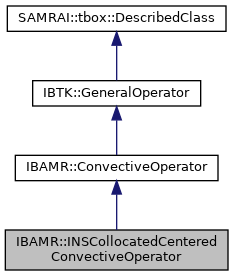
Class INSCollocatedCenteredConvectiveOperator is a concrete ConvectiveOperator which implements a centered convective differencing operator. More...
#include <ibamr/INSCollocatedCenteredConvectiveOperator.h>
Public Member Functions | |
| INSCollocatedCenteredConvectiveOperator (std::string object_name, SAMRAI::tbox::Pointer< SAMRAI::tbox::Database > input_db, ConvectiveDifferencingType difference_form, const std::vector< SAMRAI::solv::RobinBcCoefStrategy< NDIM > * > &bc_coefs) | |
| Class constructor. More... | |
| ~INSCollocatedCenteredConvectiveOperator () | |
| Destructor. More... | |
| void | applyConvectiveOperator (int U_idx, int N_idx) override |
| Compute the action of the convective operator. More... | |
| void | setAdvectionVelocity (int u_idx) |
| Set the patch data index corresponding to the advection velocity to be used when computing the convective derivative. More... | |
| int | getAdvectionVelocity () const |
| Get the patch data index corresponding to the advection velocity used when computing the convective derivative. More... | |
| void | setConvectiveDifferencingType (ConvectiveDifferencingType difference_form) |
| Set the convective differencing form to be used by the operator. More... | |
| ConvectiveDifferencingType | getConvectiveDifferencingType () const |
| Get the convective differencing form used by the operator. More... | |
General operator functionality. | |
| const std::string & | getName () const |
| Return the object name. More... | |
| virtual bool | getIsInitialized () const |
| Return whether the operator is initialized. More... | |
| virtual void | setHomogeneousBc (bool homogeneous_bc) |
| Set whether the operator should use homogeneous boundary conditions. More... | |
| virtual bool | getHomogeneousBc () const |
| Return whether the operator is using homogeneous boundary conditions. More... | |
| virtual void | setSolutionTime (double solution_time) |
| Set the time at which the solution is to be evaluated. More... | |
| virtual double | getSolutionTime () const |
| Get the time at which the solution is being evaluated. More... | |
| virtual void | setTimeInterval (double current_time, double new_time) |
| Set the current time interval. More... | |
| virtual std::pair< double, double > | getTimeInterval () const |
| Get the current time interval. More... | |
| virtual double | getDt () const |
| Get the current time step size. More... | |
| virtual void | setHierarchyMathOps (SAMRAI::tbox::Pointer< HierarchyMathOps > hier_math_ops) |
| Set the HierarchyMathOps object used by the operator. More... | |
| virtual SAMRAI::tbox::Pointer< HierarchyMathOps > | getHierarchyMathOps () const |
| Get the HierarchyMathOps object used by the operator. More... | |
| virtual void | applyAdd (SAMRAI::solv::SAMRAIVectorReal< NDIM, double > &x, SAMRAI::solv::SAMRAIVectorReal< NDIM, double > &y, SAMRAI::solv::SAMRAIVectorReal< NDIM, double > &z) |
| Compute \(z=F[x]+y\). More... | |
| virtual void | modifyRhsForBcs (SAMRAI::solv::SAMRAIVectorReal< NDIM, double > &y) |
| Modify the RHS vector to account for boundary conditions. More... | |
| virtual void | imposeSolBcs (SAMRAI::solv::SAMRAIVectorReal< NDIM, double > &u) |
| Impose boudary conditions in the solution vector. More... | |
Static Public Member Functions | |
| static SAMRAI::tbox::Pointer< ConvectiveOperator > | allocate_operator (const std::string &object_name, SAMRAI::tbox::Pointer< SAMRAI::tbox::Database > input_db, ConvectiveDifferencingType difference_form, const std::vector< SAMRAI::solv::RobinBcCoefStrategy< NDIM > * > &bc_coefs) |
| Static function to construct an INSCollocatedCenteredConvectiveOperator. More... | |
General operator functionality. | |
| void | apply (SAMRAI::solv::SAMRAIVectorReal< NDIM, double > &x, SAMRAI::solv::SAMRAIVectorReal< NDIM, double > &y) override |
| Compute \(y=F[x]\). More... | |
| ConvectiveDifferencingType | d_difference_form |
| int | d_u_idx = IBTK::invalid_index |
Logging functions. | |
| virtual void | setLoggingEnabled (bool enable_logging=true) |
| Enable or disable logging. More... | |
| virtual bool | getLoggingEnabled () const |
| Determine whether logging is enabled or disabled. More... | |
| virtual void | printClassData (std::ostream &stream) |
| Print class data to stream. More... | |
| const std::string | d_object_name |
| bool | d_is_initialized = false |
| bool | d_homogeneous_bc |
| double | d_solution_time = std::numeric_limits<double>::quiet_NaN() |
| double | d_current_time = std::numeric_limits<double>::quiet_NaN() |
| double | d_new_time = std::numeric_limits<double>::quiet_NaN() |
| SAMRAI::tbox::Pointer< HierarchyMathOps > | d_hier_math_ops |
| bool | d_hier_math_ops_external = false |
| bool | d_enable_logging = false |
Detailed Description
- See also
- INSCollocatedHierarchyIntegrator
Constructor & Destructor Documentation
◆ INSCollocatedCenteredConvectiveOperator() [1/3]
| IBAMR::INSCollocatedCenteredConvectiveOperator::INSCollocatedCenteredConvectiveOperator | ( | std::string | object_name, |
| SAMRAI::tbox::Pointer< SAMRAI::tbox::Database > | input_db, | ||
| ConvectiveDifferencingType | difference_form, | ||
| const std::vector< SAMRAI::solv::RobinBcCoefStrategy< NDIM > * > & | bc_coefs | ||
| ) |
◆ ~INSCollocatedCenteredConvectiveOperator()
| IBAMR::INSCollocatedCenteredConvectiveOperator::~INSCollocatedCenteredConvectiveOperator | ( | ) |
◆ INSCollocatedCenteredConvectiveOperator() [2/3]
|
privatedelete |
- Note
- This constructor is not implemented and should not be used.
◆ INSCollocatedCenteredConvectiveOperator() [3/3]
|
privatedelete |
- Note
- This constructor is not implemented and should not be used.
- Parameters
-
from The value to copy to this object.
Member Function Documentation
◆ allocate_operator()
|
inlinestatic |
◆ applyConvectiveOperator()
|
overridevirtual |
Implements IBAMR::ConvectiveOperator.
◆ initializeOperatorState()
|
overridevirtual |
The vector arguments for apply(), applyAdjoint(), etc, need not match those for initializeOperatorState(). However, there must be a certain degree of similarity, including
- hierarchy configuration (hierarchy pointer and level range)
- number, type and alignment of vector component data
- ghost cell widths of data in the input and output vectors
- Note
- It is generally necessary to reinitialize the operator state when the hierarchy configuration changes.
It is safe to call initializeOperatorState() when the state is already initialized. In this case, the operator state is first deallocated and then reinitialized.
Conditions on arguments:
- input and output vectors must have same hierarchy
- input and output vectors must have same structure, depth, etc.
Call deallocateOperatorState() to remove any data allocated by this method.
- See also
- deallocateOperatorState
- Parameters
-
in input vector out output vector
Reimplemented from IBTK::GeneralOperator.
◆ deallocateOperatorState()
|
overridevirtual |
- Note
- It is safe to call deallocateOperatorState() when the operator state is already deallocated.
- See also
- initializeOperatorState
Reimplemented from IBTK::GeneralOperator.
◆ operator=()
|
privatedelete |
- Note
- This operator is not implemented and should not be used.
- Parameters
-
that The value to assign to this object.
- Returns
- A reference to this object.
◆ setAdvectionVelocity()
|
inherited |
◆ getAdvectionVelocity()
|
inherited |
◆ setConvectiveDifferencingType()
|
inherited |
◆ getConvectiveDifferencingType()
|
inherited |
◆ apply()
|
overridevirtualinherited |
Before calling apply(), the form of the vectors x and y should be set properly by the user on all patch interiors on the specified range of levels in the patch hierarchy. The user is responsible for all data management for the quantities associated with the vectors. In particular, patch data in these vectors must be allocated prior to calling this method.
- Parameters
-
x input vector y output vector, i.e., \(y=F[x]\)
Conditions on Parameters:
- vectors x and y must have same hierarchy
- vectors x and y must have same structure, depth, etc.
In general, the vectors x and y cannot be the same.
- See also
- initializeOperatorState
Implements IBTK::GeneralOperator.
◆ getName()
|
inherited |
◆ getIsInitialized()
|
virtualinherited |
◆ setHomogeneousBc()
|
virtualinherited |
◆ getHomogeneousBc()
|
virtualinherited |
◆ setSolutionTime()
|
virtualinherited |
◆ getSolutionTime()
|
virtualinherited |
◆ setTimeInterval()
|
virtualinherited |
◆ getTimeInterval()
|
virtualinherited |
◆ getDt()
|
virtualinherited |
◆ setHierarchyMathOps()
|
virtualinherited |
◆ getHierarchyMathOps()
|
virtualinherited |
◆ applyAdd()
|
virtualinherited |
Before calling applyAdd(), the form of the vectors x, y, and z should be set properly by the user on all patch interiors on the specified range of levels in the patch hierarchy. The user is responsible for all data management for the quantities associated with the vectors. In particular, patch data in these vectors must be allocated prior to calling this method.
- Parameters
-
x input vector y input vector z output vector, i.e., \(z=F[x]+y\)
Conditions on Parameters:
- vectors x, y, and z must have same hierarchy
- vectors x, y, and z must have same structure, depth, etc.
In general, the vectors x and y cannot be the same.
- Note
- Subclasses may require that the operator be initialized prior to calling applyAdd().
- See also
- initializeOperatorState
- Note
- A default implementation is provided which employs apply() and SAMRAI::solv::SAMRAIVectorReal::add().
Reimplemented in IBTK::PETScSNESJacobianJOWrapper, and IBTK::PETScMatLOWrapper.
◆ modifyRhsForBcs()
|
virtualinherited |
Before calling this function, the form of the vector y should be set properly by the user on all patch interiors on the range of levels covered by the operator. All data in this vector should be allocated. The user is responsible for managing the storage for the vectors.
- Note
- The operator MUST be initialized prior to calling modifyRhsForBcs.
- See also
- initializeOperatorState
- Note
- A default implementation does not modify the RHS vector y.
Reimplemented in IBTK::SCLaplaceOperator, and IBTK::LinearOperator.
◆ imposeSolBcs()
|
virtualinherited |
Before calling this function, the form of the vector y should be set properly by the user on all patch interiors on the range of levels covered by the operator. All data in this vector should be allocated. The user is responsible for managing the storage for the vectors.
- Note
- The operator MUST be initialized prior to calling imposeSolBcs.
- See also
- initializeOperatorState
- Note
- A default implementation does not modify the sol vector u.
Reimplemented in IBTK::SCLaplaceOperator.
◆ setLoggingEnabled()
|
virtualinherited |
◆ getLoggingEnabled()
|
virtualinherited |
◆ printClassData()
|
virtualinherited |
Member Data Documentation
◆ d_coarsen_alg
|
private |
◆ d_coarsen_scheds
|
private |
◆ d_ghostfill_alg
|
private |
◆ d_ghostfill_strategy
|
private |
◆ d_ghostfill_scheds
|
private |
◆ d_bdry_extrap_type
|
private |
◆ d_hierarchy
|
private |
◆ d_coarsest_ln
|
private |
◆ d_finest_ln
|
private |
◆ d_U_var
|
private |
◆ d_U_scratch_idx
|
private |
◆ d_u_extrap_var
|
private |
◆ d_u_flux_var
|
private |
◆ d_u_extrap_idx
|
private |
◆ d_u_flux_idx
|
private |
◆ d_difference_form
|
protectedinherited |
Enumerated type that determines which form of differencing to use.
◆ d_u_idx
|
protectedinherited |
The advection velocity patch data descriptor index.
◆ d_object_name
|
protectedinherited |
◆ d_is_initialized
|
protectedinherited |
◆ d_homogeneous_bc
|
protectedinherited |
◆ d_solution_time
|
protectedinherited |
◆ d_current_time
|
protectedinherited |
◆ d_new_time
|
protectedinherited |
◆ d_hier_math_ops
|
protectedinherited |
◆ d_hier_math_ops_external
|
protectedinherited |
◆ d_enable_logging
|
protectedinherited |
The documentation for this class was generated from the following file:
- include/ibamr/INSCollocatedCenteredConvectiveOperator.h